





Quick Answer:
The best ChatGPT prompts for recruiters cover the full hiring workflow: job analysis, job descriptions, Boolean sourcing, passive candidate outreach, resume screening, interview questions, candidate scorecards, follow-ups, rejection emails, offer communication, talent retention, and candidate relationship management. The most reliable prompts include role context, hiring criteria, desired format, tone, and clear instructions to avoid unsupported assumptions.
AI prompts for recruiters work best when they do not ask ChatGPT to “just write something.” Good recruiting prompts give the AI context, constraints, examples, and an output format. That is the difference between a generic email and a message a strong candidate might actually answer.
This guide gives you practical, copy-ready ChatGPT prompts for recruiting in 2026. Use them for hiring, sourcing, screening, candidate communication, interview planning, talent retention, and recruitment CRM workflows.
Related Blog: Why AI is extremely important for Modern Recruitment CRM
Best ChatGPT Prompts for Recruiters by Hiring Task
| Recruiting task | Best prompt type | Use it for |
|---|---|---|
| Role intake | Job analysis prompt | Turning vague hiring needs into clear must-have criteria |
| Job posting | Job description prompt | Writing SEO-friendly job ads for LinkedIn, Indeed, and career pages |
| Sourcing | Boolean search prompt | Finding candidates by skill, title, industry, and location |
| Passive outreach | Personalization prompt | Creating LinkedIn InMail, email, and warm intro messages |
| Resume review | Screening prompt | Summarizing resumes against role requirements |
| Interview planning | Question prompt | Creating role-specific interview questions |
| Candidate evaluation | Rubric prompt | Building fair, structured scorecards |
| Candidate relationship management | Nurture prompt | Re-engaging silver medalists and warm talent pools |
| Hiring manager updates | Summary prompt | Turning pipeline activity into crisp stakeholder updates |
| Retention | Talent retention prompt | Understanding flight risk and improving employee engagement |
How to Write Better AI Prompts for Recruiting
OpenAI’s prompt engineering guidance emphasizes clear instructions, helpful context, examples, and specific output formats. For recruiting, that means your prompt should tell the AI what role it is helping with, what the hiring team cares about, what candidate information is available, and what the final output should look like.
Use this recruiter prompt formula:
Act as a recruiting specialist helping with [task].

Role: [job title]
Company: [company context]
Hiring goal: [why the role is open]
Must-have requirements: [skills, experience, certifications]
Nice-to-have requirements: [secondary criteria]
Candidate or market context: [resume, LinkedIn notes, location, industry, compensation range]
Output format: [bullets, table, email, scorecard, search string, interview plan]
Tone: [professional, warm, concise, executive, conversational]
Guardrails: Do not infer protected characteristics. Flag uncertainty. Ask clarifying questions if critical information is missing.
Related Blog: How to Choose the Right Type of Recruitment for Your Organization
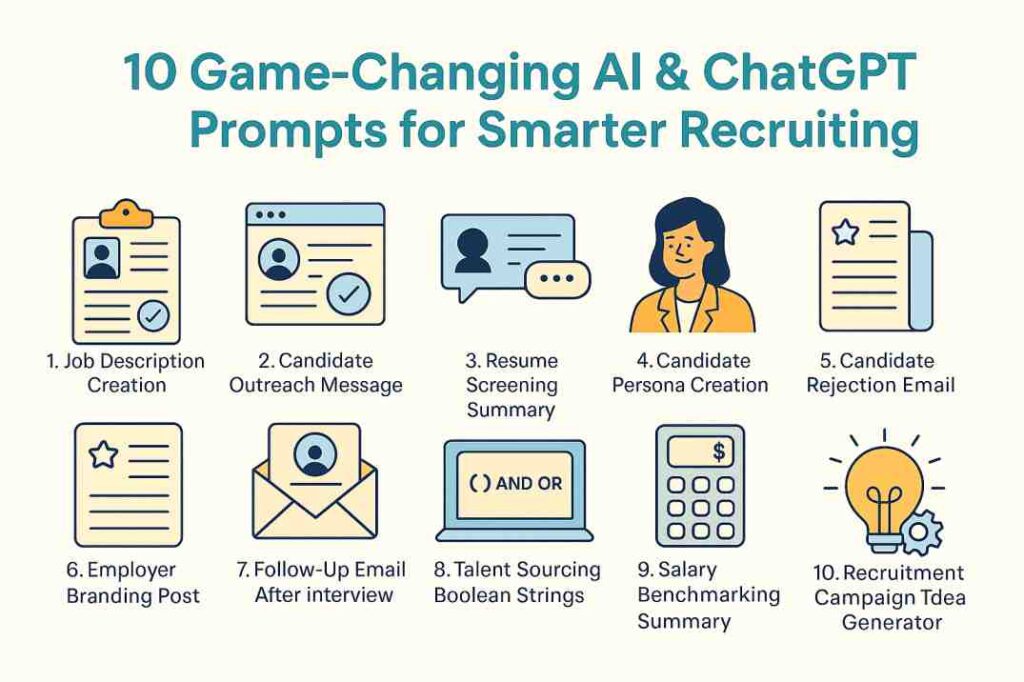
25 AI and ChatGPT Prompts for Recruiters
1. Job Intake Prompt
Prompt:
Act as a senior recruiter preparing a role intake summary.

I am hiring for [Job Title] at [Company Name]. Here is what the hiring manager shared: [paste notes].

Create a structured intake brief with:
1. Role purpose
2. Must-have skills
3. Nice-to-have skills
4. Likely target companies or industries
5. Candidate persona
6. Screening questions to confirm fit
7. Missing information I should ask the hiring manager
Why it works: This turns scattered hiring-manager notes into a cleaner search strategy before you post or source.
Related Blog: Discover 10 Free Most Powerful ATS for Small Businesses
2. SEO-Friendly Job Description Prompt
Prompt:
Create an engaging, SEO-friendly job description for [Job Title] at [Company Name].

Include:
- A clear opening summary
- Key responsibilities
- Required qualifications
- Nice-to-have qualifications
- Compensation or benefits details: [add details]
- Work model: [remote, hybrid, onsite]
- Location: [location]
- Equal opportunity statement

Use a clear, candidate-first tone. Avoid jargon, inflated requirements, and biased language. Naturally include keywords candidates would search for, such as [keyword 1], [keyword 2], and [keyword 3].
Why it works: It targets both job-board visibility and candidate readability.
Related Blog: Recruiting made easy: 9 JazzHR Competitors You Need to Know
3. Inclusive Job Description Review Prompt
Prompt:
Review this job description for clarity, inclusiveness, and unnecessary barriers: [paste job description].

Return:
1. Requirements that may be too broad or unrealistic
2. Words or phrases that may discourage qualified applicants
3. Suggestions to make the role clearer
4. A revised version under [word count] words
5. A short note explaining what changed
Why it works: It helps recruiters improve job descriptions before they unintentionally narrow the candidate pool.
4. Boolean Search String Prompt
Prompt:
Generate Boolean search strings for sourcing [Job Title] candidates.

Must-have skills: [skills]
Nice-to-have skills: [skills]
Location: [location or remote]
Seniority: [level]
Industries to prioritize: [industries]
Titles to include: [titles]
Titles to exclude: [titles]

Create:
1. A broad LinkedIn search string
2. A precise LinkedIn search string
3. A Google X-ray search string
4. Synonyms and alternate titles I should test
Why it works: It expands candidate search without losing control of relevance.
Related Blog: The Best ATS+CRM Alternatives to Loxo for Growing Teams
5. Passive Candidate Sourcing Strategy Prompt
Prompt:
Build a sourcing strategy for passive candidates for [Job Title].

Role requirements: [requirements]
Target candidate profile: [persona]
Location: [location]
Industry: [industry]
Hiring difficulty: [low, medium, high]

Give me:
- Best sourcing channels
- Target companies
- Search keywords
- Outreach angles
- Likely candidate objections
- A 7-day sourcing plan
Why it works: It connects search, messaging, and pipeline planning instead of treating sourcing as a one-off keyword exercise.
6. LinkedIn InMail Personalization Prompt
Prompt:
Write a concise LinkedIn InMail to [Candidate Name] for a [Job Title] role.

Candidate notes: [paste profile notes]
Company: [Company Name]
Role highlights: [role details]
Why this candidate may fit: [specific reason]

Keep it under 120 words. Start with a personalized first line, avoid generic praise, explain why the role is relevant, and end with a low-pressure question.
Why it works: Candidates ignore mass outreach. This prompt forces relevance and brevity.
Related Blog: 12 Best Recruitment CRM for Recruitment Agencies - Complete Guide
7. Cold Recruiting Email Prompt
Prompt:
Write a cold recruiting email for a passive candidate.

Role: [Job Title]
Candidate background: [candidate details]
Company value proposition: [why the company is attractive]
Compensation or growth details: [details]
Tone: warm, direct, and respectful

Create 3 subject lines and one email under 150 words. Do not overpromise. Include a simple call to action for a 15-minute conversation.
Why it works: It gives recruiters a usable email plus subject-line options to test.
Related Blog: Steal These Free Recruiting Email Templates That Get Responses
8. Warm Intro Request Prompt
Prompt:
Write a warm intro request I can send to [Mutual Connection] asking for an introduction to [Candidate Name].

Context:
- Candidate background: [details]
- Role: [Job Title]
- Why the candidate may be a fit: [reason]
- Relationship with mutual connection: [context]

Keep it brief, respectful, and easy for the mutual connection to forward.
Why it works: Warm introductions often outperform cold outreach, especially for senior or niche roles.
9. Candidate Follow-Up Prompt
Prompt:
Draft a follow-up email to [Candidate Name] after they showed interest in [Job Title].

Include:
- Thanks for their response
- One reason the role matches their background
- Next step in the process
- Timeline
- A friendly question asking for availability

Tone: professional, warm, and concise.
Why it works: Clear follow-up reduces candidate drop-off and keeps momentum moving.
Related Blog: Make Recruitment Easier: Best Free ATS Tools to Handle Hiring
10. Resume Screening Summary Prompt
Prompt:
Review this resume against the job requirements below.

Resume: [paste resume]
Job requirements: [paste requirements]

Return:
1. Overall fit: strong, possible, or weak
2. Evidence that supports the fit
3. Gaps or concerns
4. Skills to verify in screening
5. 5 role-specific follow-up questions

Do not make assumptions about protected characteristics or personal background.
Why it works: It gives recruiters a structured review while keeping the final decision with the hiring team.
Related Blog: Best RecruiterFlow Alternatives for Small & Medium Recruiting Firms
11. Candidate Evaluation Rubric Prompt
Prompt:
Create a candidate evaluation rubric for [Job Title].

Use these hiring criteria: [criteria].

Format the rubric as questions that start with "Did the candidate..." and include:
- 5 core competencies
- 3 score levels for each competency
- What strong evidence looks like
- What weak evidence looks like
- Red flags to verify through interview questions
Why it works: Structured rubrics reduce vague feedback and help interviewers compare candidates more consistently.
12. Phone Screen Question Prompt
Prompt:
Create a 20-minute recruiter phone screen for [Job Title].

Include:
- Opening script
- Motivation questions
- Experience questions
- Compensation and availability questions
- Work authorization or location logistics where appropriate
- Candidate questions to expect
- Closing script

Keep questions job-related and avoid anything that could introduce bias.
Why it works: Recruiters get a repeatable screen that still leaves room for human conversation.
13. Interview Question Prompt
Prompt:
Create interview questions for [Job Title] based on these competencies: [competencies].

For each competency, include:
- 2 behavioral questions
- 1 technical or role-specific question
- What a strong answer should include
- Follow-up probes
Why it works: It helps hiring teams evaluate actual evidence rather than relying on gut feel.
14. Hiring Manager Debrief Prompt
Prompt:
Summarize this interview feedback into a hiring-manager debrief.

Feedback notes: [paste notes]
Role: [Job Title]

Return:
1. Candidate strengths
2. Concerns
3. Evidence from interview notes
4. Open questions
5. Recommended next step

Use neutral, job-related language.
Why it works: It converts messy interview notes into decision-ready summaries.
15. Candidate Rejection Email Prompt
Prompt:
Write a respectful rejection email for a candidate who interviewed for [Job Title].

Context:
- Candidate name: [name]
- Stage reached: [screen, interview, final round]
- Strengths to acknowledge: [strengths]
- Reason for not moving forward, if shareable: [reason]

Keep the message kind, brief, and professional. Invite them to stay connected for relevant future roles if appropriate.
Why it works: A good rejection protects candidate relationships and employer brand.
Related Blog: The Ultimate Recruit CRM Showdown: Best ATS Ranked
16. Candidate Nurture Prompt
Prompt:
Create a candidate nurture sequence for warm candidates in our talent pool.

Audience: [candidate segment]
Roles they may fit: [roles]
Company updates: [updates]
Tone: helpful, human, and low-pressure

Write 4 short emails over 60 days. Each email should have a clear reason for reaching out and a soft call to action.
Why it works: It keeps candidate relationship management active instead of letting good candidates go cold.
Related Blog: When Your CRM Fails To Deliver On Recruiting
17. Silver Medalist Re-Engagement Prompt
Prompt:
Write a re-engagement email for a silver medalist candidate.

Candidate background: [details]
Previous role considered: [role]
New role: [role]
Why this new role may be a better fit: [reason]

Make it personal, acknowledge the previous process, and ask whether they would be open to reconnecting.
Why it works: Past strong candidates are often faster to engage than brand-new prospects.
18. Employer Branding Post Prompt
Prompt:
Create a LinkedIn employer branding post for [Company Name].

Theme: [career growth, team culture, diversity and inclusion, remote work, learning, mission]
Audience: [candidate persona]
Proof points: [employee story, benefit, milestone, quote]

Write one polished post, one shorter version, and 3 suggested hashtags. Keep it authentic and avoid corporate buzzwords.
Why it works: Employer branding content gives passive candidates a reason to remember the company before a job pitch arrives.
Related Blog: The Best Bullhorn Alternative for Effortless Hiring
19. Recruitment Campaign Idea Prompt
Prompt:
Suggest 5 recruitment campaign ideas for attracting [candidate audience].

Hiring goal: [goal]
Roles: [roles]
Budget level: [low, medium, high]
Channels available: [LinkedIn, email, events, referrals, job boards]

For each idea, include the core message, best channel, content format, and success metric.
Why it works: It helps recruiters move beyond posting jobs and waiting for applicants.
Related Blog: How to drive Recruitment Leads via Blog+ Social Media
20. Salary Benchmarking Prompt
Prompt:
Help me prepare a salary benchmarking summary for [Job Title] in [Location].

Use this available compensation data: [paste reliable compensation notes or ranges].

Return:
- Entry, mid, and senior ranges
- Factors that may affect compensation
- Risks if the range is below market
- Suggested recruiter talking points

Flag any uncertainty and do not present estimates as verified facts unless the data supports them.
Why it works: It helps recruiters turn compensation inputs into a clear internal conversation.
21. Offer Communication Prompt
Prompt:
Draft an offer-stage email for [Candidate Name] for [Job Title].

Include:
- Congratulations
- Role title and team
- High-level compensation or benefits details: [details]
- Next steps
- Timeline for response
- Recruiter contact information

Tone: enthusiastic, clear, and professional.
Why it works: Offer communication should feel exciting while staying accurate and easy to understand.
22. Candidate Objection Handling Prompt
Prompt:
Create response options for a candidate who is hesitant about [objection].

Role: [Job Title]
Candidate motivation: [motivation]
Company strengths: [strengths]
Constraints we must be honest about: [constraints]

Give me 3 responses:
1. Short email
2. Phone talking points
3. Follow-up message

Do not pressure the candidate or hide tradeoffs.
Why it works: It keeps recruiter responses thoughtful instead of defensive.
23. Talent Retention Prompt
Prompt:
Act as an HR and talent retention advisor.

We want to improve retention for [team or role group].
Context: [turnover signals, engagement feedback, manager notes, market pressure]

Identify:
- Possible retention risks
- Questions managers should ask in stay interviews
- Actions we can take in the next 30 days
- Longer-term improvements
- Metrics to monitor
Why it works: Recruiting does not end at offer acceptance. Retention prompts help talent teams reduce preventable churn.
24. Recruitment Lead Generation Prompt
Prompt:
Act as a recruitment agency business development assistant.

Target market: [industry, company size, location]
Service: [permanent hiring, contract staffing, executive search, RPO]
Ideal client pain points: [pain points]

Create:
1. A prospect research checklist
2. 5 hiring-trigger signals to monitor
3. A cold email
4. A LinkedIn connection note
5. A follow-up message
Why it works: Agency recruiters can use AI prompts for both candidate sourcing and client pipeline building.
25. Recruitment CRM Update Prompt
Prompt:
Turn these recruiter notes into a clean CRM update.

Notes: [paste call notes, email notes, or interview notes]
Candidate or client: [name]
Role: [role]
Pipeline stage: [stage]

Return:
- Summary
- Important details
- Next action
- Follow-up date suggestion
- Tags or categories to add
Why it works: Clean CRM notes make handoffs easier and keep pipeline reporting reliable.
Prompt Expansion Examples for Recruiters
Many recruiters start with a short prompt like “write a recruiting email.” The output usually sounds generic because the AI has no real context. Prompt expansion means adding the missing role, audience, goal, evidence, tone, and constraints.
| Weak prompt | Better recruiter prompt |
|---|---|
| Write a job post for a sales role. | Write a candidate-first job post for a remote B2B SaaS Account Executive role selling to mid-market HR teams. Include quota expectations, required sales cycle experience, compensation range, benefits, and a clear equal opportunity statement. |
| Screen this resume. | Compare this resume against the attached senior backend engineer requirements. Summarize evidence for must-have skills, gaps to verify, and five interview questions. Do not infer personal traits not supported by the resume. |
| Write a LinkedIn message. | Write a 90-word LinkedIn InMail to a passive DevOps candidate who has Kubernetes and AWS experience. Mention their cloud migration work, connect it to our platform reliability role, and end with a low-pressure question. |
| Make interview questions. | Create 8 structured interview questions for a customer success manager role. Map each question to one competency and include what a strong answer should demonstrate. |
Best AI Prompts for Hiring Teams
For hiring teams, the most useful AI prompts are the ones that create alignment before candidate evaluation starts. These prompts help recruiters and hiring managers agree on what “qualified” actually means.
| Hiring need | Prompt to use |
|---|---|
| Clarify a role | ”Turn these hiring-manager notes into must-have and nice-to-have requirements.” |
| Improve a job ad | ”Rewrite this job description to be clearer, more inclusive, and easier for candidates to scan.” |
| Find candidates | ”Create Boolean search strings and alternate titles for this role.” |
| Evaluate fairly | ”Create a structured rubric using job-related criteria only.” |
| Improve communication | ”Draft a short candidate update email with the next step and timeline.” |
| Retain talent | ”Create stay interview questions and 30-day retention actions for this team.” |
Related Blog: 5 Tips To Close More Placements Using ATZ CRM
What Recruiters Should Not Use ChatGPT For
AI can speed up recruiting work, but recruiters should not outsource judgment entirely. Avoid using ChatGPT to make final hiring decisions, infer demographic information, rank candidates based on protected characteristics, create misleading salary claims, or send messages without human review.
Use AI as a drafting and analysis assistant. Keep recruiters, hiring managers, and compliance reviewers responsible for decisions that affect candidates.
How ATZ CRM Helps Recruiters Use AI Outputs
Prompts are useful, but hiring teams still need a place to manage the work after the AI output is created. ATZ CRM helps recruiters organize jobs, candidates, notes, communication, pipeline stages, and follow-ups in one system.
Recruiters can use the prompts above to create better messaging and then manage the candidate relationship inside ATZ CRM, from first outreach to interview feedback and offer follow-up.
Related Blog: The Ultimate Recruit CRM Showdown: Best ATS Ranked
FAQ
1. What are AI prompts and how do they help recruiters?
AI prompts are instructions given to tools like ChatGPT so they can produce a specific recruiting output. Recruiters use prompts to draft job descriptions, personalize outreach, summarize resumes, create interview questions, and manage follow-up communication faster.
2. What are the best ChatGPT prompts for recruiters?
The best ChatGPT prompts for recruiters include job description prompts, Boolean sourcing prompts, candidate outreach prompts, resume screening prompts, interview question prompts, candidate evaluation rubric prompts, rejection email prompts, and talent nurture prompts.
3. What is a good ChatGPT prompt for recruiting passive candidates?
A good passive-candidate prompt includes the role, candidate profile notes, why the role is relevant, company selling points, desired message length, tone, and a low-pressure call to action. The more specific the candidate context, the better the outreach will sound.
4. Can I use ChatGPT to screen resumes?
Yes, but use it as a support tool. Ask ChatGPT to summarize evidence against job-related criteria, identify gaps to verify, and create follow-up questions. Do not let AI make the final hiring decision without human review.
5. Which ChatGPT prompt works best for job descriptions?
The best job description prompt asks for the role title, responsibilities, must-have requirements, nice-to-have qualifications, work model, location, compensation details, benefits, candidate-first tone, SEO keywords, and an equal opportunity statement.
6. How do I write prompts that help AI return better job leads?
Tell the AI your target industry, company size, hiring triggers, role types, geography, decision-maker titles, and exclusion criteria. Then ask for a prospect checklist, target account ideas, outreach angles, and follow-up copy.
Conclusion
The best AI and ChatGPT prompts for recruiters are specific, job-related, and easy to review. They help recruiters move faster across sourcing, outreach, screening, interviews, offers, and candidate relationship management, but they still need human judgment.
Use the prompts in this guide as starting points, then customize them with real role details, candidate context, and hiring-team priorities. When paired with a recruitment CRM, AI prompts become more than copywriting shortcuts; they become repeatable hiring workflows.