





Quick Answer:
The best Bullhorn alternatives for recruiting firms in 2026 are ATZ CRM, Recruiterflow, JobAdder, Vincere, Loxo, Ceipal, Manatal, JobDiva, Workable, and Greenhouse.
If your main reason for leaving Bullhorn is complexity, cost, or recruiter adoption, start with tools that combine ATS + CRM, automation, sourcing, reporting, and client workflows in one place. ATZ CRM is the strongest fit for small and mid-size agencies that want smoother UX, AI matching, transparent pricing, and fast onboarding without a heavy enterprise rollout.
Bullhorn is one of the best-known names in staffing software. For large agencies with complex operations, deep integrations, and a long history inside the Bullhorn ecosystem, it can still make sense.
But many recruiting firms search for Bullhorn alternatives because the day-to-day workflow feels heavier than it needs to be. Recruiters want faster candidate search, cleaner pipelines, less admin, better automation, and software that does not require a long implementation cycle before the team can use it confidently.
That is especially true for small and mid-size recruitment agencies, direct hire firms, and executive search teams. They usually do not need every enterprise module. They need a practical recruitment CRM that helps consultants move from sourcing to outreach to submission to placement without fighting the system.
This guide compares the strongest Bullhorn competitors and alternatives based on the queries real recruiters are already searching: smoother user experience, automation, direct hire staffing, executive search, ATS + CRM fit, job board workflows, mobile usability, and pricing clarity.
Bullhorn Alternatives Compared at a Glance
| Platform | Best fit | Starting price | Strongest advantage | Main tradeoff |
|---|---|---|---|---|
| ATZ CRM | Small and mid-size recruiting firms | From $12/user/month | ATS + CRM, AI matching, automation, reporting, free trial | Less necessary if you only need enterprise staffing back office |
| Recruiterflow | Outbound direct hire teams | From $149/user/month | Email sequences, ATS + CRM, agency automation | Higher entry price |
| JobAdder | Job-board-heavy agencies | Custom quote | Job board distribution and clean daily workflow | Less transparent public pricing |
| Vincere | Larger staffing operations | From £69/user/month | Staffing operating system, analytics, process control | Heavier setup for smaller teams |
| Loxo | Sourcing-heavy executive search | From $169/user/month | Talent database, sourcing, ATS + CRM | Cost rises when sourcing depth is needed |
| Ceipal | Workforce and vendor-led staffing | Custom quote | ATS, VMS, workforce management | Can feel broad for smaller direct hire teams |
| Manatal | Budget-conscious teams | From $19/user/month | Affordable ATS with AI matching | CRM depth is lighter |
| JobDiva | High-volume staffing firms | Custom quote | Search, matching, back-office-style staffing workflows | Can be overwhelming for new users |
| Workable | In-house hiring teams | From $299/month | Job posting and collaborative hiring | Not agency-first CRM |
| Greenhouse | Structured in-house hiring | Custom quote | Interview structure and enterprise hiring process | Not built around client CRM or placements |
Why Recruiting Firms Look for Bullhorn Alternatives
Bullhorn is not weak software. The issue is fit.
Recruitment agencies do not all operate like enterprise staffing firms. A five-person direct hire agency, a retained search boutique, a healthcare staffing team, and a 200-person temp staffing company need different workflows.
Bullhorn is often evaluated because it has strong brand recognition, but agencies start comparing alternatives when they run into a few practical issues.
Recruiter adoption
Recruiters spend all day inside the system. If the interface feels slow, crowded, or difficult to configure, adoption drops. The result is familiar: notes end up in email, follow-ups live in spreadsheets, and managers lose visibility.
A smoother Bullhorn alternative should reduce clicks, make search easier, and keep candidate, client, job, and communication history connected.
Automation without add-on complexity
Many firms want automation for outreach, tasks, candidate matching, follow-ups, job alerts, and reporting. The question is whether automation feels native to the workflow or like another layer to configure and maintain.
If consultants need separate tools for email sequences, reporting, sourcing, and CRM activity, the total cost and admin load can climb quickly.
Pricing and total cost
Bullhorn’s small-agency pricing page lists Starter at $99/user/month and Core at $165/user/month, while Pro is custom priced and adds CRM, AI, automation, analytics, and a dedicated account manager according to Bullhorn pricing.
That can be reasonable for some staffing firms, but smaller teams often compare alternatives because they want a lower starting price, clearer included features, and fewer add-on decisions.
Agency model fit
Direct hire agencies need sales CRM, candidate pipelines, submissions, interviews, and placement tracking. Executive search firms need deep relationships, longlists, confidential notes, and passive sourcing. Temp and contract staffing firms need availability, compliance, onboarding, timesheets, and sometimes pay-and-bill.
The best Bullhorn competitor is not simply the tool with the most features. It is the one that matches how your agency makes placements.
Best Bullhorn Alternatives and Competitors for Recruiting Firms
The list below focuses on recruiting use case, not generic HR software popularity.
1. ATZ CRM
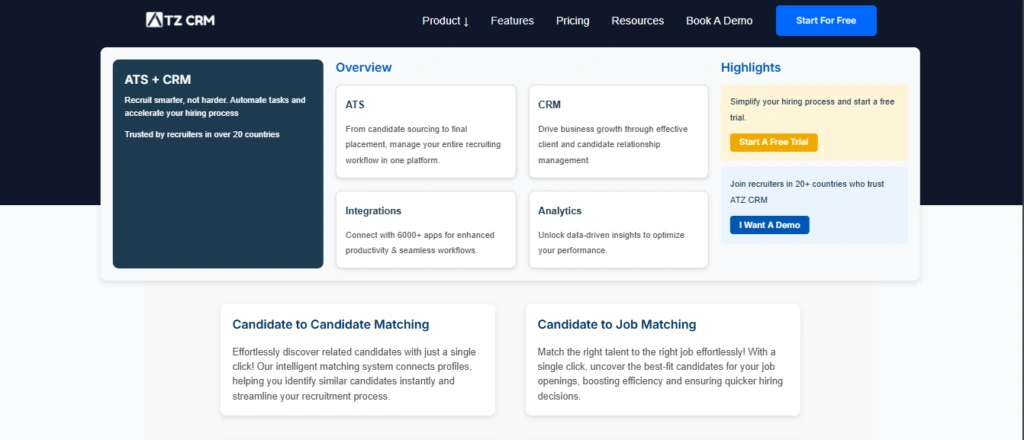
ATZ CRM is the best Bullhorn alternative for small and mid-size recruitment agencies that want ATS, CRM, sourcing, outreach, automation, AI matching, and reporting in one platform.
It is built around agency work: candidate pipelines, client relationships, job orders, submissions, email communication, notes, tasks, sales pipeline tracking, and recruiter performance visibility. That makes it different from corporate hiring tools that mostly focus on applicants and hiring managers.
Pricing: ATZ CRM starts at $12/user/month and offers a free plan/trial experience with no credit card required according to ATZ CRM pricing.
Best for: Direct hire agencies, staffing firms, executive search teams, and growing recruitment businesses that want a smoother user experience than Bullhorn without splitting ATS and CRM work across multiple tools.
Where it stands out vs Bullhorn:
- Unified ATS + CRM for candidates, clients, jobs, deals, and follow-ups.
- AI job-to-candidate matching and similar candidate search.
- Email templates, triggers, sequencing, and candidate outreach.
- Reports for source-of-hire, recruiter productivity, funnel activity, and revenue.
- Transparent pricing that is easier for small and mid-size teams to forecast.
- Unlimited jobs, candidate sourcing extension, job board posting, and sales pipeline features.
What to check: If your firm requires a very specific enterprise back-office setup, confirm the workflow before switching. For most direct hire, perm, executive search, and mixed recruiting teams, ATZ CRM is a cleaner fit than an enterprise-heavy system.
For a direct product comparison, review ATZ CRM vs Bullhorn.
2. Recruiterflow
Recruiterflow is a strong Bullhorn competitor for agencies that care most about outbound recruiting automation. It combines ATS, CRM, email sequences, automation, and reporting in one agency-focused platform.
Recruiterflow’s pricing page lists its Platform Plan at $149/user/month, with the AIRA plan on custom pricing according to Recruiterflow pricing.
Best for: Outbound direct hire teams, recruitment agencies that rely on email sequences, and firms that want more modern automation than legacy staffing systems.
Where it stands out vs Bullhorn: Recruiterflow is more focused on agency automation, multichannel sequences, and candidate/client management without the same enterprise staffing footprint.
What to check: The entry price is much higher than budget ATS options. If your team needs broader sales CRM, pricing flexibility, and AI features at a lower cost, compare it carefully with ATZ CRM.
3. JobAdder
JobAdder is a practical Bullhorn alternative for agencies that rely heavily on job boards and applicant flow. It is popular in markets where job distribution, quick candidate processing, and a clean recruiter interface matter more than deep enterprise customization.
JobAdder uses custom pricing, so agencies need to request a quote before comparing total cost.
Best for: Job-board-heavy agencies, staffing teams in ANZ or UK markets, and recruiters who want a cleaner daily workflow than a heavier legacy system.
Where it stands out vs Bullhorn: JobAdder is often considered easier to adopt and strong for job ad distribution. That makes it relevant for agencies that do not need every Bullhorn enterprise module.
What to check: If your growth depends more on proactive sourcing, AI matching, client CRM, and outreach automation, job-board strength alone may not be enough.
4. Vincere
Vincere is one of the closer Bullhorn alternatives for staffing firms that still want a full agency operating system. It covers ATS, CRM, reporting, and staffing workflows with more operational depth than lightweight tools.
Vincere’s pricing page says its CRM and ATS starts from £69/user/month, with AI modules added on top from £25/agency/month according to Vincere pricing.
Best for: Mid-market staffing firms, larger recruitment agencies, and teams that need more process control than a lightweight ATS offers.
Where it stands out vs Bullhorn: Vincere gives agencies another full-stack staffing option with stronger public pricing clarity than many enterprise tools.
What to check: Smaller agencies may find the setup heavier than they need. If your main pain is UX and speed, compare how quickly your team can get productive.
5. Loxo
Loxo is a strong option for sourcing-heavy agencies, especially executive search and direct hire firms that want candidate discovery built into the recruiting platform.
Loxo’s pricing page lists a free plan and a Basic plan at $169/user/month according to Loxo pricing.
Best for: Executive search firms, passive sourcing teams, and recruiters who want talent intelligence and outreach features inside the same system.
Where it stands out vs Bullhorn: Loxo can reduce dependency on separate sourcing databases and outbound tools.
What to check: The features that make Loxo attractive are often tied to higher-value sourcing workflows. If your agency does not need a sourcing database at the center of the platform, compare cost carefully.
6. Ceipal
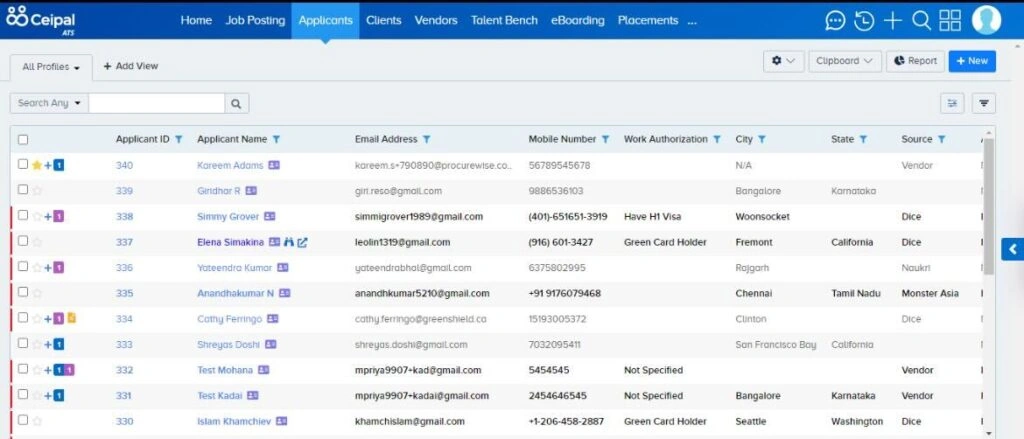
Ceipal is a Bullhorn alternative for staffing firms that need ATS, vendor management, workforce management, and automation across a broader staffing operation.
Pricing: Ceipal uses custom pricing on its main website, so agencies should request a quote based on user count, staffing model, and required modules.
Best for: Staffing firms that work with vendors, subcontractors, workforce management, or high-volume recruiting workflows.
Where it stands out vs Bullhorn: Ceipal can be attractive when the agency needs more than candidate tracking and client CRM. Its broader workforce and vendor features may support complex staffing operations.
What to check: Direct hire or executive search teams may find the platform broader than necessary. Evaluate whether the extra operational modules will actually be used.
7. Manatal
Manatal is a budget-friendly ATS + recruitment CRM option with AI recommendations, candidate enrichment, collaboration, and reporting.
Manatal’s pricing page lists its Professional plan at $19/user/month and Enterprise at $39/user/month according to Manatal pricing.
Best for: Small teams, budget-conscious agencies, and recruiters moving away from spreadsheets or basic ATS tools.
Where it stands out vs Bullhorn: Manatal is much cheaper at entry level and easier to test for teams that do not need Bullhorn’s enterprise footprint.
What to check: CRM depth, automation, reporting, and high-volume agency workflows may be lighter than what growing agencies eventually need.
8. JobDiva
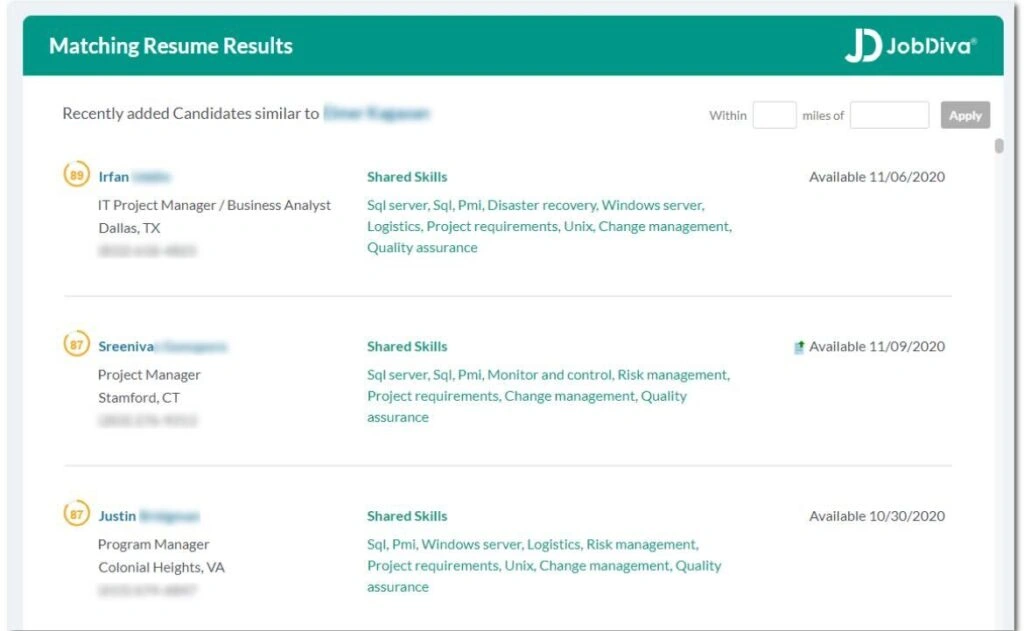
JobDiva is a staffing-focused platform known for high-volume recruiting, candidate search, matching, CRM, onboarding, and operational staffing workflows.
Pricing: JobDiva uses custom pricing, so agencies should request a quote based on team size and required modules.
Best for: High-volume staffing firms, IT staffing agencies, and teams that need search-heavy workflows with operational depth.
Where it stands out vs Bullhorn: JobDiva is often compared directly with Bullhorn for staffing operations, especially when candidate search and matching are central to the workflow.
What to check: New users can find broad staffing platforms overwhelming. Ask for a workflow demo based on your actual job order, submission, and placement process.
9. Workable
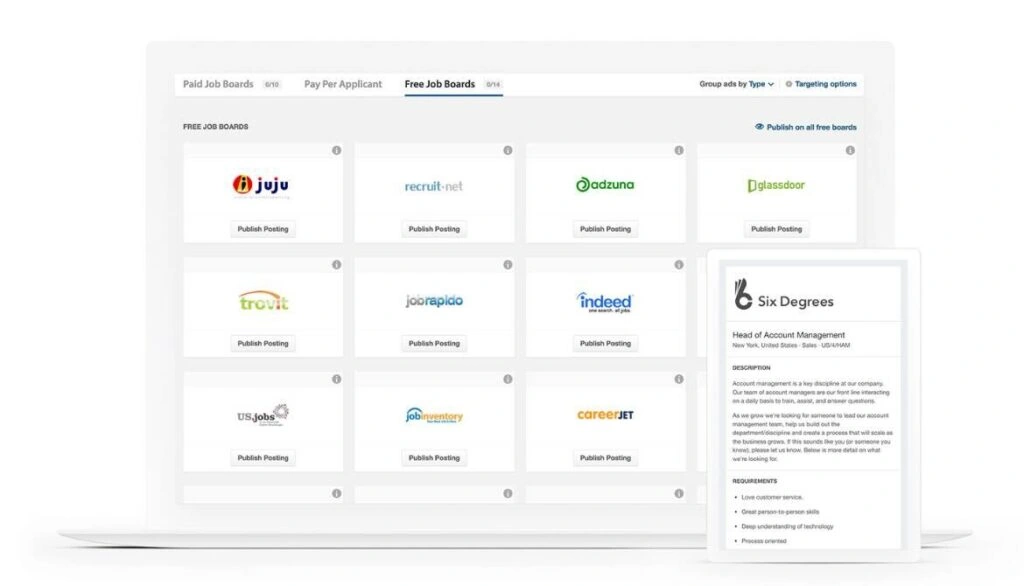
Workable is a polished hiring platform with job posting, candidate management, collaborative hiring, and AI-assisted sourcing features.
Pricing: Workable’s entry-level public pricing starts from $299/month for its Standard plan according to Workable pricing, though larger teams usually need a higher plan or custom quote.
Best for: In-house hiring teams and companies that want broad job posting and collaborative hiring workflows.
Where it stands out vs Bullhorn: Workable is easier for internal teams that do not need a full recruitment agency CRM.
What to check: Recruitment agencies should be careful. Workable is not primarily built around client development, submissions, placement revenue, or multi-client candidate ownership.
10. Greenhouse
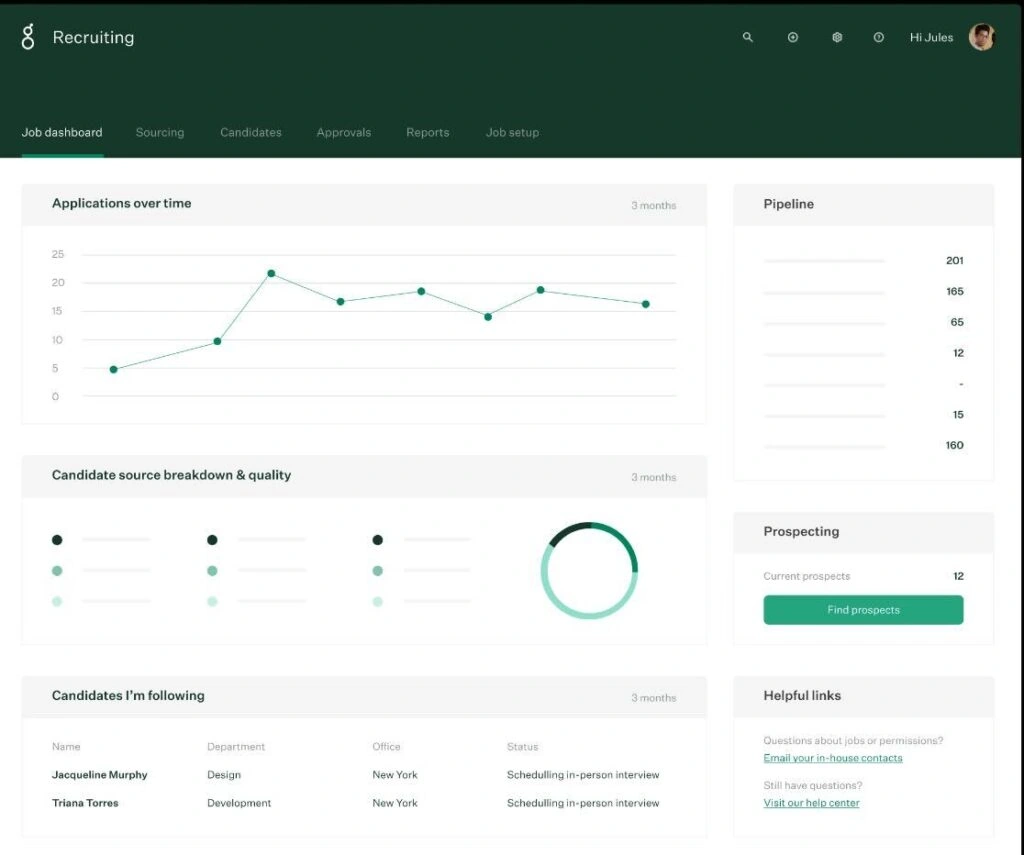
Greenhouse is a strong ATS for structured in-house hiring, interview scorecards, hiring manager collaboration, and enterprise talent acquisition workflows.
Pricing: Greenhouse uses custom pricing.
Best for: Internal talent acquisition teams that need structured hiring and interview process control.
Where it stands out vs Bullhorn: Greenhouse is often cleaner for corporate hiring teams that do not need staffing CRM depth.
What to check: For recruitment agencies, Greenhouse usually lacks the client CRM, BD pipeline, placement tracking, and multi-client workflow that make agency software useful.
Bullhorn vs Alternatives by Recruiting Use Case
Different teams leave Bullhorn for different reasons. Use the shortlist below to narrow the decision before booking demos.
| Use case | Best alternatives to compare | Why |
|---|---|---|
| Smoother UX and automation for consultants | ATZ CRM, Recruiterflow, JobAdder | Cleaner daily workflow, outreach automation, and easier adoption |
| Direct hire staffing | ATZ CRM, Recruiterflow, Loxo | Candidate pipelines, outreach, client CRM, submissions, and placement tracking |
| Executive search | ATZ CRM, Loxo, Recruiterflow, Vincere | Relationship history, passive sourcing, longlists, client notes, and confidential workflows |
| High-volume staffing | Vincere, Ceipal, JobDiva, ATZ CRM | Operational depth, matching, bulk workflows, reporting, and staffing process control |
| Budget-conscious teams | ATZ CRM, Manatal | Lower entry pricing and faster evaluation |
| Job-board-led agencies | JobAdder, Workable, ATZ CRM | Posting workflows, applicant flow, and candidate tracking |
How to Compare Bullhorn Competitors
A Bullhorn competitor should not be judged only on whether it has an ATS and CRM. Most do. The better question is whether the platform improves the work your recruiters repeat every day.
ATS + CRM in one workspace
Recruiting firms need candidate and client context together. A consultant should be able to see candidate history, client conversations, job requirements, submissions, interviews, and follow-ups without jumping between separate systems.
For agencies that want this structure, compare ATZ CRM’s recruitment CRM with your current Bullhorn workflow.
Automation that supports recruiters
Good automation should remove admin, not create more configuration work. Look for email sequences, reminders, job-to-candidate matching, status triggers, note summaries, and reporting automation.
If automation is the main reason you are switching, review workflow automation for recruiters.
Reporting that managers can actually use
Recruiting leaders need visibility into source-of-hire, submissions, interviews, placement ratios, recruiter activity, job order health, and revenue. If reports require manual exports every week, the system is not solving the problem.
Pricing clarity
Ask what is included in the base plan and what requires add-ons. AI matching, automation, analytics, LinkedIn sync, SMS, job posting, client portals, and migration can change the real cost.
Migration support
Bullhorn migrations need planning. Before switching, map candidates, contacts, companies, jobs, submissions, notes, attachments, tags, activities, ownership, consent data, and custom fields.
If you want a safer migration path, review zero-downtime data migration.
When Bullhorn Is Still the Right Choice
Not every agency should leave Bullhorn.
Bullhorn may still be the right choice if your agency is large, deeply integrated into the Bullhorn ecosystem, and relies on enterprise staffing workflows that would be expensive to rebuild elsewhere.
It can also make sense if your team depends heavily on Bullhorn marketplace integrations, back-office tools, VMS connections, or a long-standing database structure that works well enough to justify staying.
In that case, the smarter move may be optimization rather than migration. Clean your data, simplify workflows, audit unused modules, retrain recruiters, and renegotiate your contract before deciding to switch.
Is ATZ CRM the Right Bullhorn Alternative for Your Agency?
ATZ CRM is a strong fit if your agency wants a modern recruitment CRM with smoother UX, transparent pricing, built-in AI, and practical automation.
It is especially useful when your current process looks like this:
- Candidate data is in the ATS, but client follow-ups are somewhere else.
- Recruiters use email, spreadsheets, LinkedIn, WhatsApp, and notes separately.
- Managers struggle to see source-of-hire, recruiter activity, or placement pipeline health.
- Bullhorn feels more complex than your agency’s actual workflow requires.
- You want a faster way to manage direct hire, executive search, or mixed recruitment pipelines.
The best Bullhorn alternative is not always the biggest platform. It is the system your recruiters will actually use every day.
For many small and mid-size recruiting firms, that means a simpler ATS + CRM with AI matching, sourcing, outreach, reporting, and client workflows in one place. That is exactly where ATZ CRM fits.
FAQs
What is the best Bullhorn alternative for recruiters?
ATZ CRM is a strong Bullhorn alternative for recruiters who want ATS, CRM, sourcing, automation, AI matching, reporting, and client workflows in one simpler platform. Recruiterflow, JobAdder, Vincere, Loxo, Ceipal, Manatal, and JobDiva are also worth comparing based on agency model.
Which recruitment CRM provides a smoother user experience and automation compared to Bullhorn for consultants?
ATZ CRM is built for recruiters who want a smoother ATS + CRM experience with AI matching, email sequences, candidate sourcing, reporting, and client management in one workspace. Recruiterflow is also strong for outbound automation, while JobAdder is known for a cleaner job-board-led workflow.
What are the best ATS alternatives to Bullhorn?
The best ATS alternatives to Bullhorn include ATZ CRM, Recruiterflow, JobAdder, Vincere, Loxo, Ceipal, Manatal, JobDiva, Workable, and Greenhouse. Agencies should compare CRM depth, automation, migration, reporting, job board integrations, and total cost.
What is the best Bullhorn alternative for direct hire staffing?
For direct hire staffing, ATZ CRM is a strong fit because it combines candidate pipelines, client CRM, AI matching, sourcing, outreach, notes, submissions, and reporting. Recruiterflow is useful for outbound-heavy direct hire teams, while Loxo is useful when passive candidate sourcing is the main workflow.
What is the best Bullhorn alternative for executive search firms?
Executive search firms should prioritize relationship history, client notes, passive candidate sourcing, longlist management, outreach, and confidential workflows. ATZ CRM, Loxo, Recruiterflow, and Vincere are common options depending on budget, sourcing depth, and reporting needs.
Is Ceipal one of the top choices for mid-size recruiting firms?
Ceipal can be a good choice for mid-size staffing firms that need ATS, vendor management, workforce management, and high-volume recruiting workflows. For direct hire or executive search teams that want a simpler ATS + CRM, compare Ceipal against ATZ CRM, Recruiterflow, Loxo, and Vincere.
Does Bullhorn offer a free trial?
Bullhorn’s pricing page says it does not currently offer a free trial. Agencies can book a demo and request a quote. If hands-on testing is important, compare alternatives that offer a free trial or free plan before committing.
Can I migrate from Bullhorn to another ATS or recruitment CRM?
Yes. Most modern recruitment CRM platforms support migration from Bullhorn through CSV exports, API connections, or managed migration. Before switching, audit candidates, contacts, jobs, notes, pipeline stages, submissions, activities, consent data, and reporting fields.
What should I compare in Bullhorn vs JobDiva?
Compare search and matching, high-volume staffing workflows, onboarding, reporting, CRM depth, support, implementation time, and total cost. JobDiva is often considered by staffing firms that need search-heavy workflows, while Bullhorn remains strong for large staffing operations with broad integrations.