EN
EN DE
DE ES
ES FR
FR NL
NL PT
PT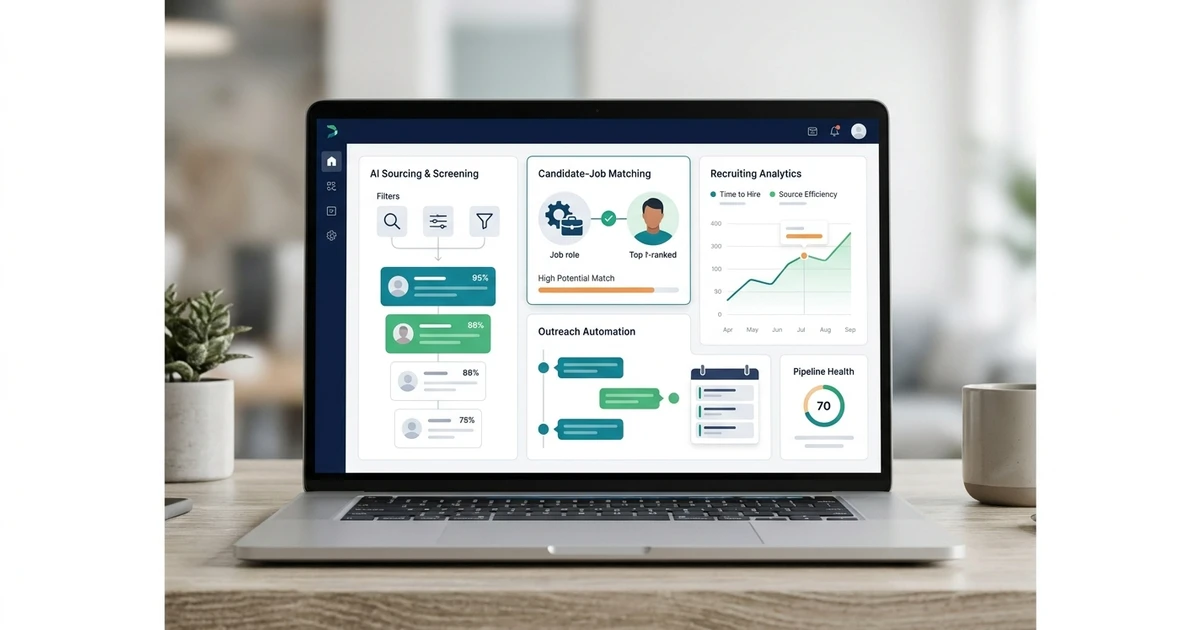


Quick Answer:
The best AI recruiting tools help recruiters automate sourcing, screening, candidate matching, outreach, ATS updates, interview scheduling, and reporting.
Strong options include ATZ CRM, Paradox, Eightfold AI, SeekOut, hireEZ, Co-recruit, Pin, Flint, HireVue, Textio, and GoPerfect.
For small recruitment agencies, start with an AI-powered ATS + CRM so candidate data, client activity, outreach, and reporting stay connected.
AI hiring software has moved from “nice to try” to practical recruiting infrastructure. Recruiters are using AI to reduce manual sourcing, summarize interviews, automate candidate matching, write better outreach, update records, and understand which activities actually lead to placements.
That shift is visible in the data. SHRM’s 2025 Talent Trends research found that AI adoption in HR tasks climbed to 43% in 2025, up from 26% in 2024. SHRM also reports that nearly 9 in 10 HR professionals whose organizations use AI for recruiting say it saves time or increases efficiency.
But “AI recruiting tool” is a broad phrase. Some tools are ATS + CRM platforms with native AI. Some are sourcing engines. Some are interview assistants. Some write job content. Some help agencies find clients, not candidates. This guide breaks the market into practical use cases so recruiters, staffing firms, and small agencies can choose the right tool without buying a disconnected stack.
Best AI Recruiting Tools at a Glance
| Tool | Best for | Main AI use case | Budget fit |
|---|---|---|---|
| ATZ CRM | Recruitment agencies needing ATS + CRM | AI matching, sourcing, outreach, notes, reporting | Strong for small and mid-size teams |
| Paradox | High-volume frontline hiring | Chatbot screening and scheduling | Better for larger hiring teams |
| Eightfold AI | Enterprise talent intelligence | Skills inference and workforce matching | Enterprise |
| SeekOut | Technical and specialist sourcing | Passive candidate discovery | Mid-market to enterprise |
| hireEZ | Outbound sourcing teams | Talent search and outreach | Mid-market to enterprise |
| Co-recruit | Recruiter assistant workflows | Notes, ATS updates, candidate submissions | Useful for agency admin reduction |
| Pin | AI sourcing and outreach | Candidate search, matching, outreach | Useful for sourcing-heavy teams |
| Flint | Recruitment agency business development | Hiring-signal lead research and outreach | Useful for client acquisition |
| HireVue | Video interviewing at scale | Structured interview screening | Enterprise and high volume |
| Textio | Recruitment content | Job post and outreach language optimization | Best for content-heavy teams |
| GoPerfect | Semantic search for niche roles | Contextual candidate discovery | Useful for hard-to-fill roles |
How to Choose Recruitment AI Software
Before comparing logos, define the workflow you want AI to improve. Most recruiters do not need 11 tools. They need one or two that solve the biggest bottleneck without scattering candidate data across different systems.
Use this checklist:
- Sourcing: Can the tool find passive candidates beyond applicants already in your inbox?
- Screening: Can it rank candidates by fit without relying only on exact keywords?
- ATS integration: Does the data land in your applicant tracking system automatically?
- CRM integration: Can it manage client, contact, job, and candidate relationships together?
- Communication: Does it support email, SMS, LinkedIn, WhatsApp, or chatbot workflows?
- Reporting: Can you see which sources, recruiters, messages, and clients create outcomes?
- Compliance: Does it support consent, data retention, auditability, and recruiter review?
- Budget: Does the pricing make sense for your team size and hiring volume?
If you are a small recruitment agency, start with a platform that combines ATS, CRM, sourcing, outreach, matching, and reporting. Standalone AI tools can be powerful, but they often create extra admin when they do not sync cleanly with your main database.
1. ATZ CRM
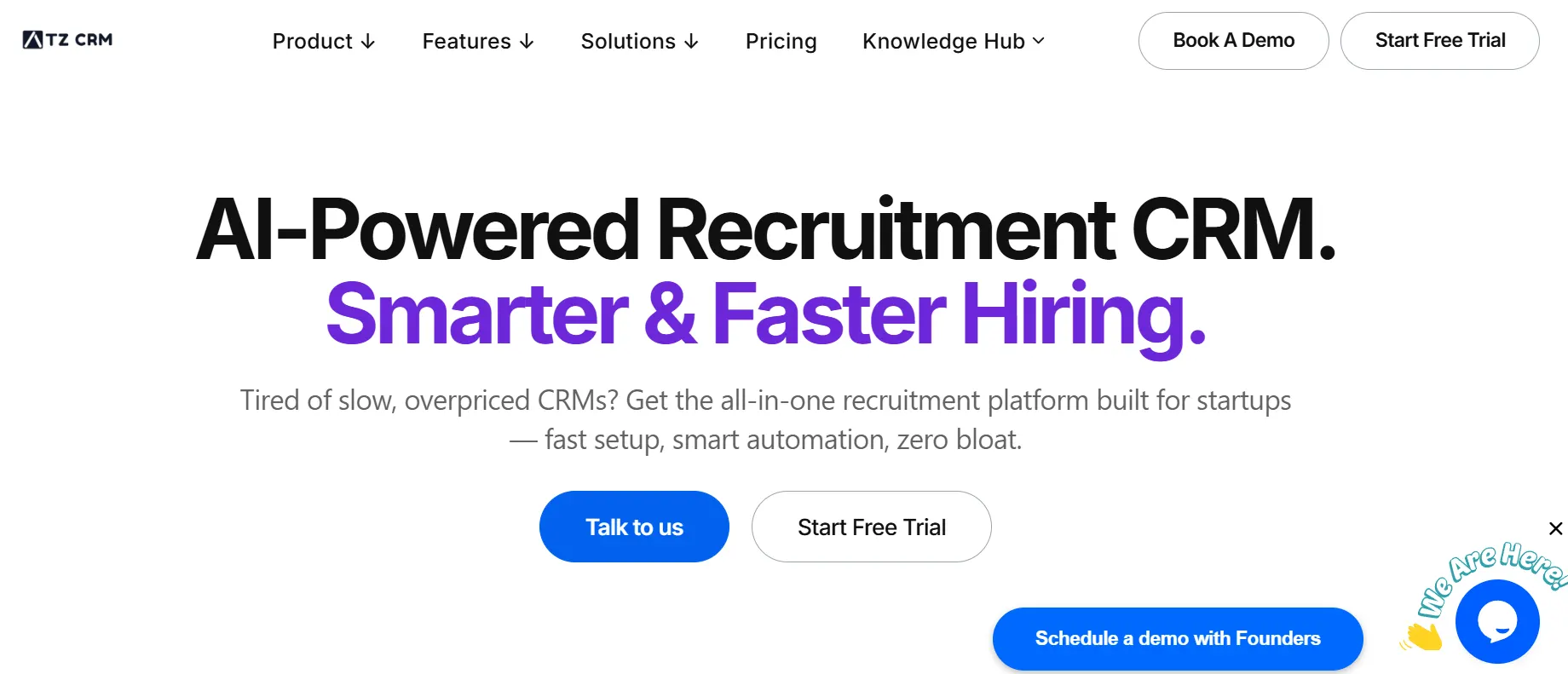
ATZ CRM is an AI-powered recruitment CRM and applicant tracking system built for recruitment agencies, staffing firms, and solo recruiters that want one operating system for candidates, clients, jobs, outreach, and reporting.
Overview: ATZ CRM is strongest when you do not want to stitch together a separate ATS, CRM, sourcing tool, email tool, note taker, and reporting dashboard. Recruiters can manage candidate pipelines, client activity, job orders, outreach, submissions, and placements from one place.
AI features: The platform includes AI job matching, similar candidate discovery, AI candidate sourcing, resume parsing, AI application scoring, meeting notes, AI content generation, automated email sequences, and reporting dashboards. For agencies, the important part is that these features sit inside the ATS + CRM workflow instead of living in a separate tab.
Best for: Small and mid-size recruitment agencies, staffing firms, solo recruiters, and BD-focused recruiting teams that need AI tools for recruiters with CRM integration.
Pricing: From $12/user/month. ATZ CRM also offers an unlimited free trial with no credit card required.
Why recruiters compare it: It answers several search intents at once: budget AI recruitment tool, AI-based staffing CRM, CRM-connected AI hiring software, automatic candidate matching, and AI recruitment reporting.
Useful internal resources:
- Learn how AI matching works in ATZ CRM’s candidate matching guide.
- Compare broader CRM workflows in the recruitment CRM guide.
- Review product-level analytics on the reports and dashboards page.
2. Paradox
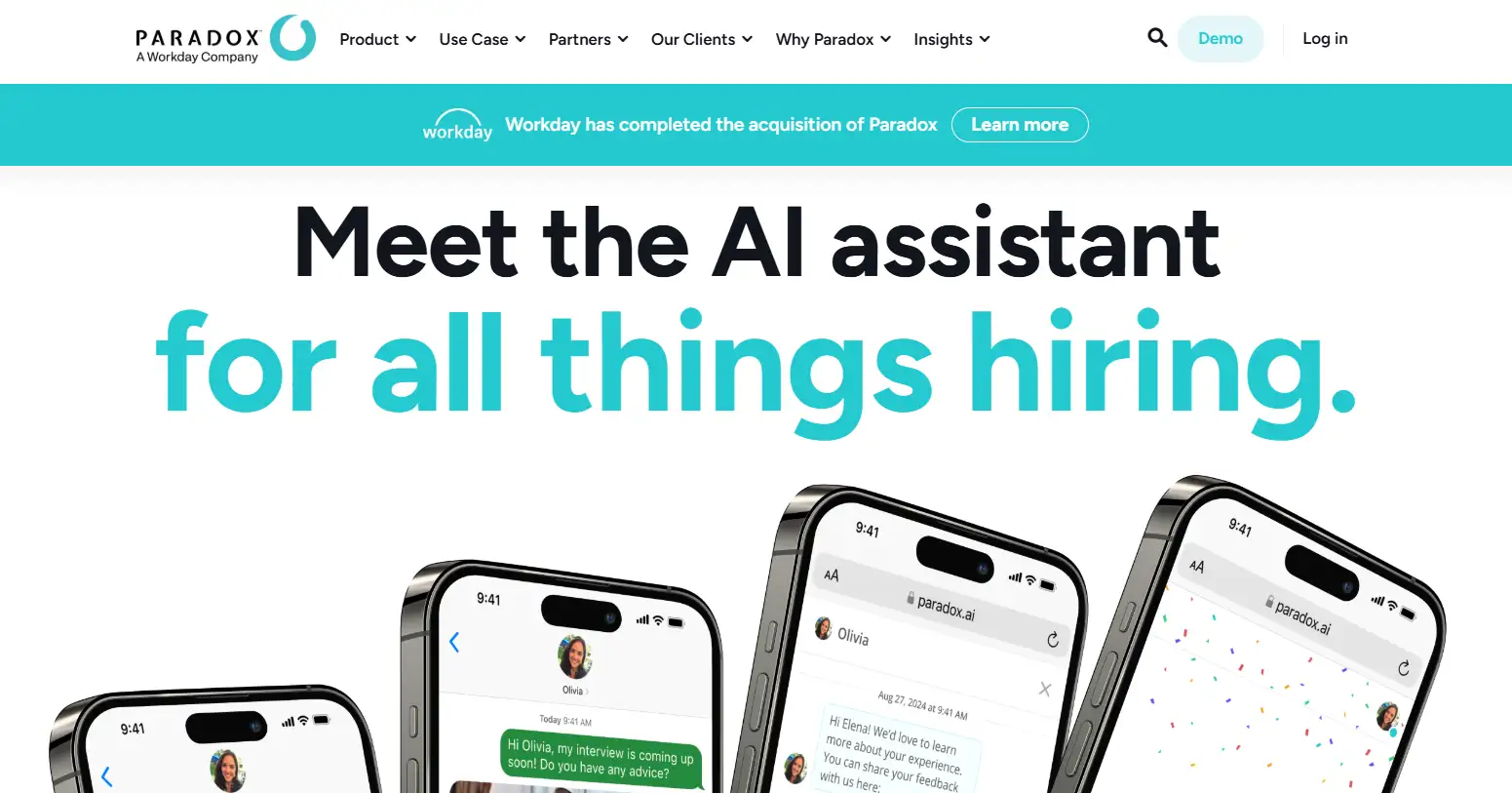
Paradox is best known for conversational recruiting and high-volume candidate engagement. Its AI assistant, Olivia, helps teams answer candidate questions, screen applicants, and schedule interviews through chat-based workflows.
Overview: Paradox is useful when your hiring problem is speed at the very top of the funnel. Retail, hospitality, healthcare support, and frontline hiring teams often need candidates to move from interest to scheduled interview within minutes, not days.
AI features: Chatbot screening, automated interview scheduling, candidate Q&A, hiring event support, and high-volume engagement workflows.
Best for: Enterprise or high-volume teams that receive many hourly or frontline applications and need fast candidate response.
Pricing: Usually custom and based on organization size, volume, and implementation needs.
Watch out for: If your agency needs deep client CRM, business development, candidate ownership, and placement reporting, chatbot automation alone will not replace your core recruiting system.
3. Eightfold AI
Eightfold AI focuses on talent intelligence. It is built for large organizations that need skills-based matching, workforce planning, internal mobility, and enterprise talent data.
Overview: Eightfold is not just a sourcing add-on. It is a broader talent intelligence platform that helps enterprise teams understand skills, career paths, and workforce gaps across internal and external talent.
AI features: Skills inference, candidate matching, internal mobility recommendations, talent intelligence, workforce planning, and diversity-focused analytics.
Best for: Enterprise talent teams, global organizations, and companies with complex internal mobility or workforce planning needs.
Pricing: Custom enterprise pricing.
Watch out for: It may be more platform than a small agency needs if the immediate goal is affordable sourcing, candidate matching, and CRM-connected outreach.
4. SeekOut
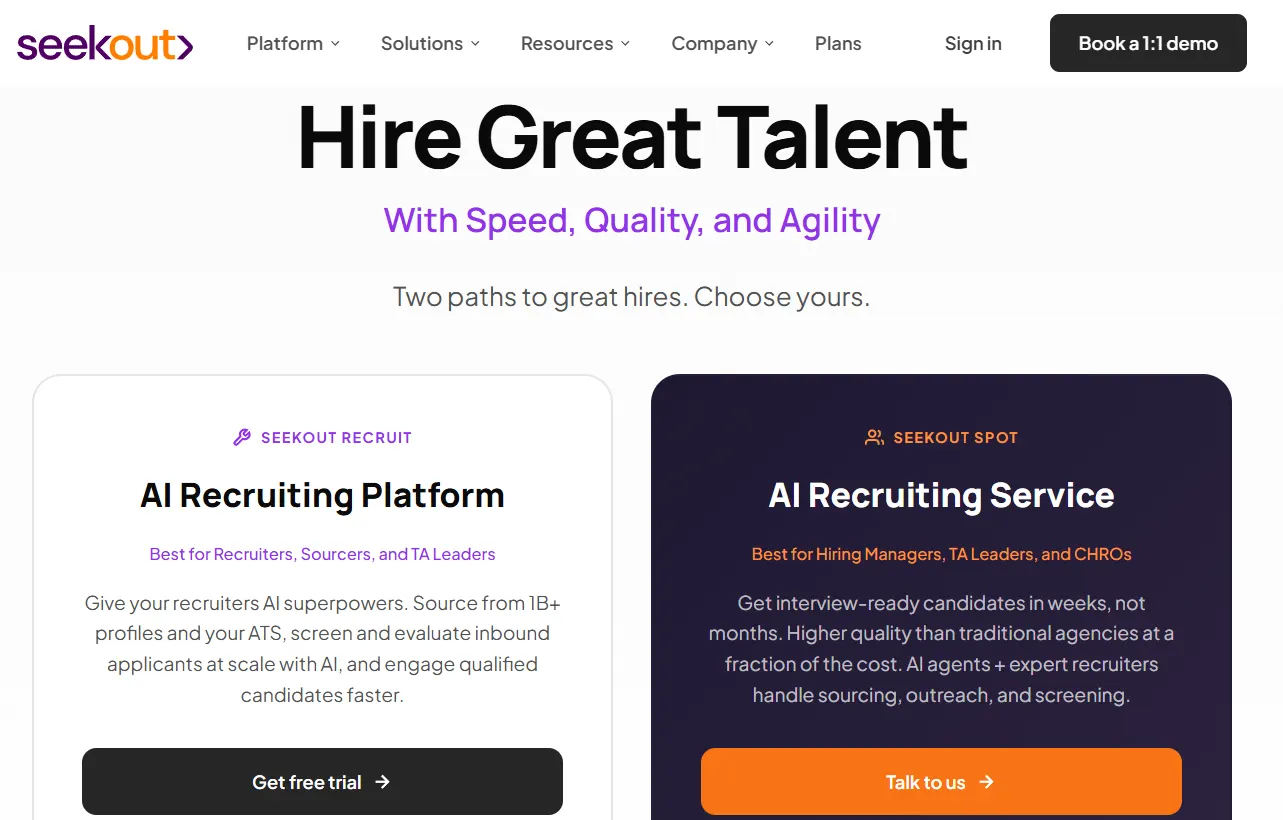
SeekOut is a sourcing-focused AI recruiting solution for technical, specialist, and hard-to-find candidate searches.
Overview: Recruiters use SeekOut when they need to search broad talent pools, identify passive candidates, and understand market availability. It is especially relevant for technical recruiting, cleared roles, executive search, and specialized skill sets.
AI features: Candidate discovery, semantic search, profile enrichment, talent pool analytics, and search assistance for specialist roles.
Best for: Technical recruiters, executive search teams, and sourcing teams working on niche roles.
Pricing: Custom or sales-led, depending on seats and package.
Watch out for: Sourcing tools are most effective when the discovered candidates flow cleanly into your ATS or CRM. If they do not, recruiters may still lose time on exports and manual updates.
5. hireEZ
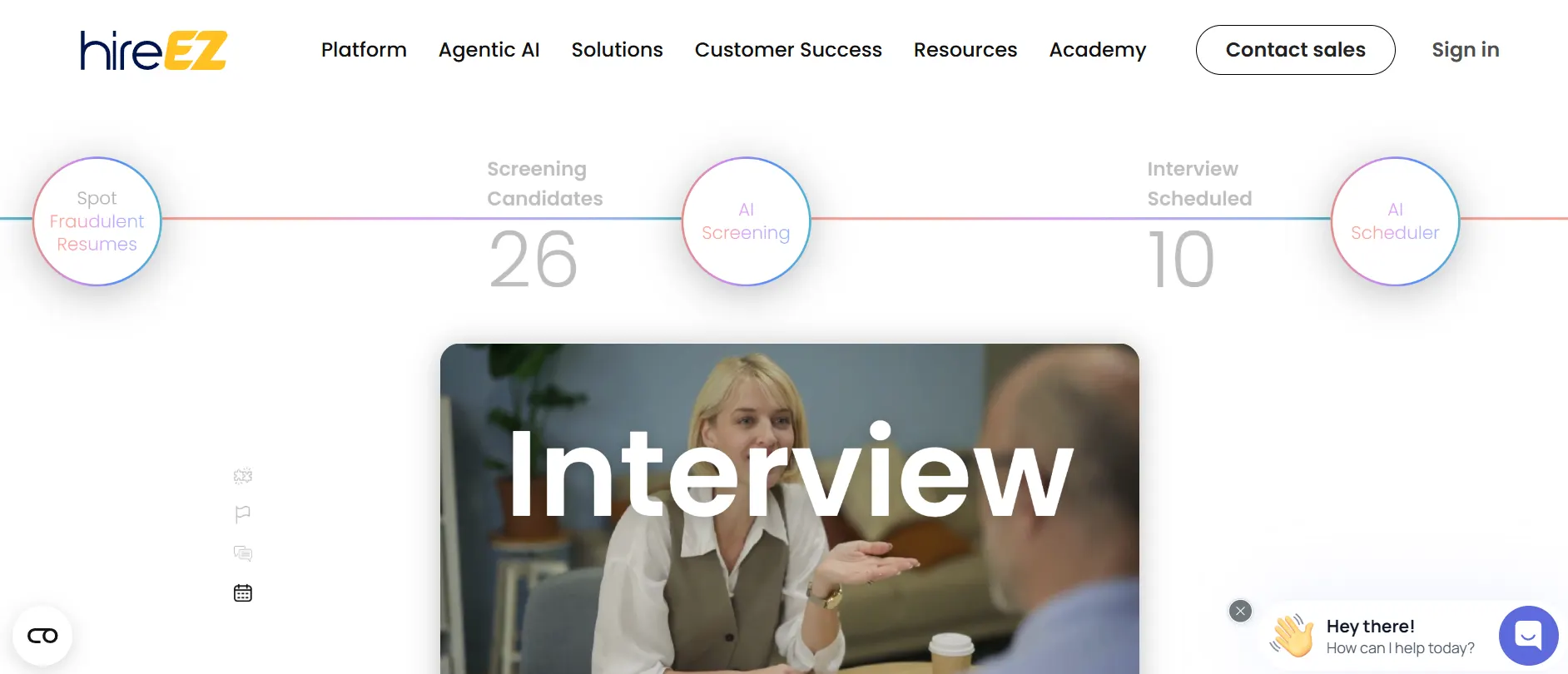
hireEZ is built for outbound recruiting teams that need candidate sourcing and outreach in one workflow.
Overview: It helps recruiters find passive candidates, enrich profile data, and launch outreach sequences. For teams that live in outbound sourcing, it can reduce the manual work of searching, finding contact details, and following up.
AI features: AI-assisted candidate search, talent rediscovery, profile enrichment, automated outreach, and campaign workflows.
Best for: Agency recruiters, in-house sourcing teams, and outbound-heavy recruiting teams.
Pricing: Custom pricing based on seats and package.
Watch out for: If your main pain is client pipeline, placement reporting, or recruiter productivity across the full agency workflow, pair sourcing tools with a proper recruitment CRM.
6. Co-recruit
Co-recruit is a recruiter assistant tool category worth watching because it targets a painful part of agency life: the admin that happens after the call.
Overview: Recruiters do not only need help finding candidates. They also need help with interview notes, ATS updates, call summaries, candidate submissions, follow-up tasks, and searchable conversation history. This is where AI-based recruiter assistant tools can create real weekly time savings.
AI features: AI note-taking, meeting summaries, ATS updates, candidate submission drafts, call intelligence, and recruiter workflow assistance.
Best for: Solo recruiters, agency recruiters, and teams that spend too much time writing notes, updating records, and creating candidate summaries after interviews.
Pricing: Public pricing may vary by plan and usage. Check current pricing before buying.
Watch out for: A recruiter assistant is valuable, but it should not become another disconnected place where candidate intelligence gets trapped.
7. Pin
Pin is an AI sourcing and outreach platform designed to help recruiters discover, evaluate, and engage candidates faster.
Overview: The rise of tools like Pin reflects a clear market shift: recruiters want AI search that understands natural language and candidate context, not only Boolean strings and job-title matching. For hard-to-fill roles, this can make sourcing faster and more precise.
AI features: Natural-language candidate search, AI matching, profile evaluation, outreach drafting, sequence automation, and pipeline support.
Best for: Sourcing-heavy recruiters, tech hiring teams, and agencies that need alternatives or complements to traditional professional-network search.
Pricing: Pricing may vary by plan, user count, and credits.
Watch out for: Credit-based sourcing tools can become expensive if teams do not define outreach volume and candidate quality standards before rollout.
8. Flint
Flint is different from most AI recruitment tools because it focuses on agency client acquisition rather than candidate acquisition.
Overview: Recruitment agencies do not only need candidates. They need companies with active hiring demand. AI tools in this category research companies, identify hiring signals, find decision-makers, and help recruiters launch personalized business development outreach.
AI features: Hiring-signal research, client lead discovery, contact research, message generation, outreach sequencing, and market monitoring.
Best for: Recruitment agency founders, solo recruiters, and BD teams that want AI support for finding new clients.
Pricing: Pricing may vary by number of agents, users, or lead volume.
Watch out for: Client-side AI is powerful only when your CRM can track target accounts, contacts, conversations, jobs, follow-ups, and revenue outcomes.
9. HireVue
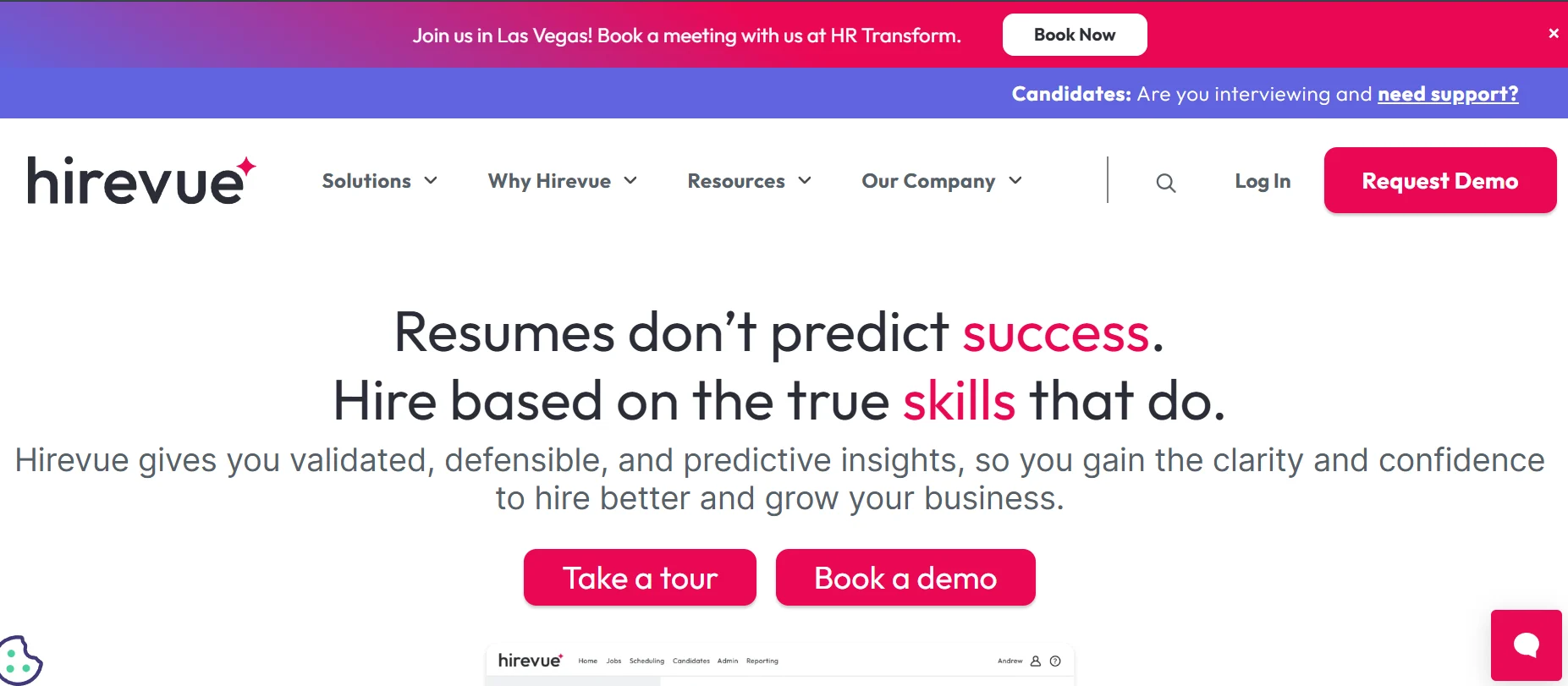
HireVue is an enterprise interview and assessment platform for teams that need structured candidate screening at scale.
Overview: Video interviewing and AI-supported assessments can help recruiters handle large applicant volumes without scheduling every first-round screen manually. This is most useful in high-volume roles where consistent first-round evaluation matters.
AI features: Structured video interviews, assessment workflows, interview intelligence, scheduling support, and candidate evaluation tools.
Best for: Enterprise hiring teams, high-volume hiring, early-career programs, and remote-first screening.
Pricing: Custom enterprise pricing.
Evidence note: University of Chicago Booth research on AI-led interviews found that candidates interviewed by an AI voice agent were 12% more likely to receive job offers, 18% more likely to start, and 16% more likely to remain after 30 days. That does not mean every AI interview tool will produce the same result, but it shows why structured AI screening is becoming a serious category.
10. Textio
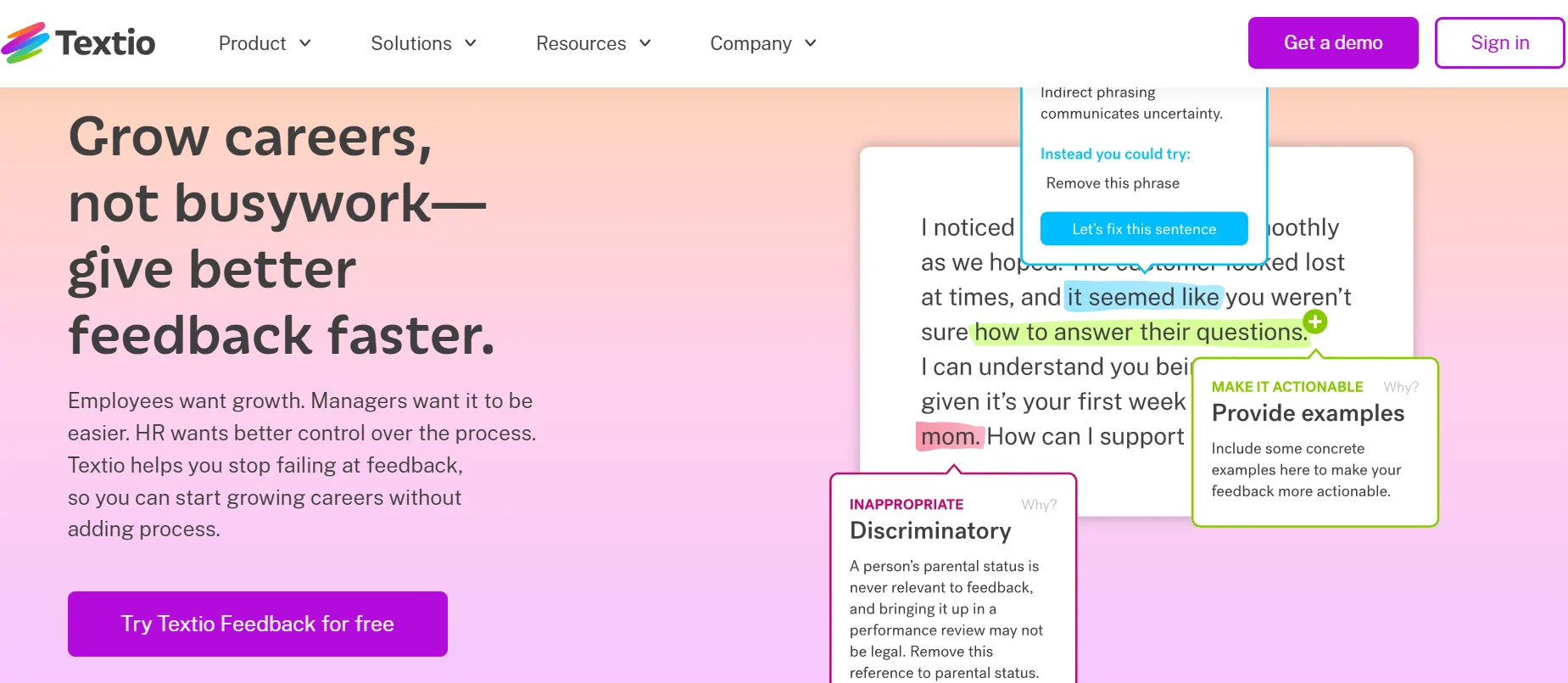
Textio helps hiring teams improve recruiting content, especially job descriptions, employer-brand language, and candidate-facing messages.
Overview: AI content tools are useful when job posts are unclear, biased, generic, or underperforming. Better content can improve applicant quality and reduce friction before candidates ever enter the funnel.
AI features: Job description optimization, inclusive language suggestions, performance scoring, and content recommendations for recruiting teams.
Best for: Talent acquisition teams, employer branding teams, and companies posting many roles across different functions.
Pricing: Usually sales-led or enterprise-oriented.
Watch out for: Content tools improve the top of funnel, but they do not replace candidate tracking, sourcing, matching, or CRM workflows.
11. GoPerfect
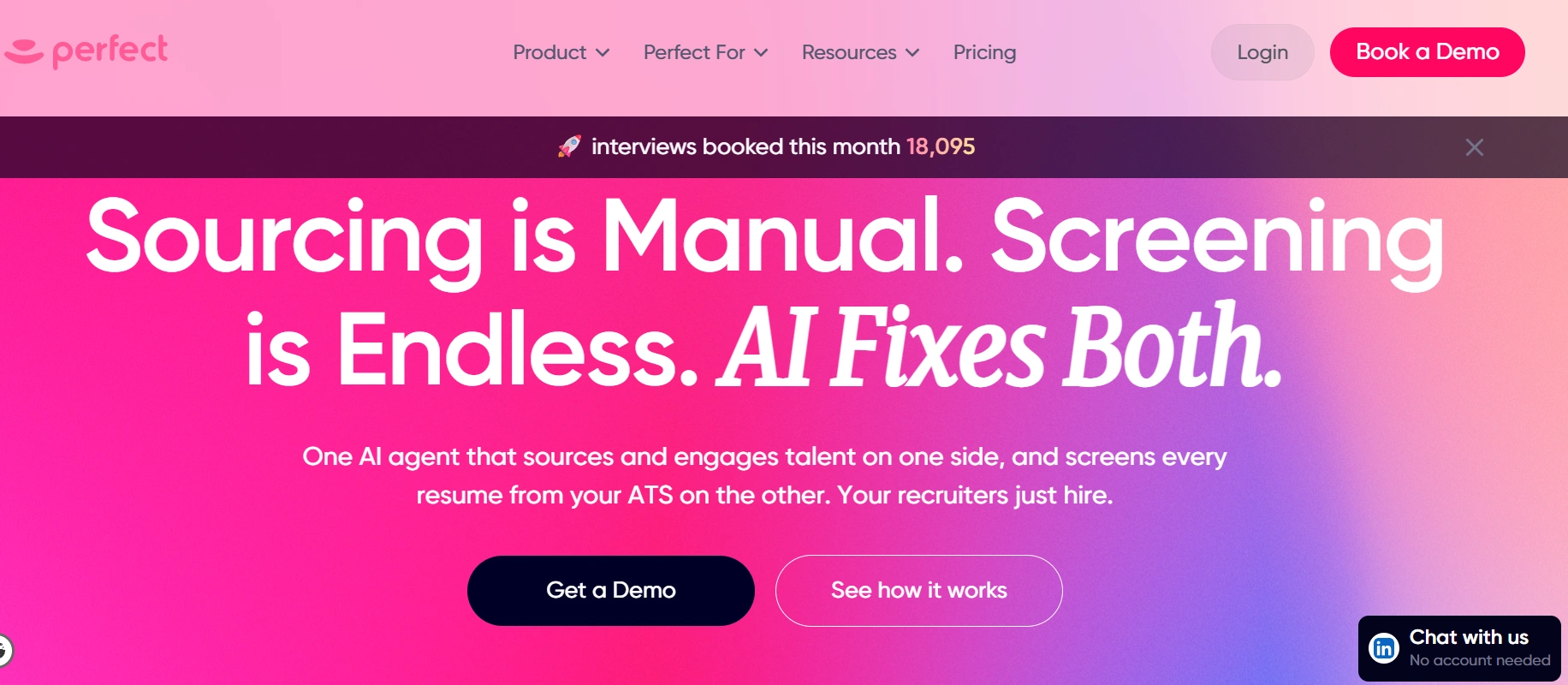
GoPerfect is a semantic search and candidate discovery tool for teams working on technical or specialized roles.
Overview: The value of semantic search is that it understands context. A strong AI sourcing tool should recognize related skills, career paths, and role intent, even when resumes do not contain the exact keyword a recruiter typed.
AI features: Semantic candidate search, match reasoning, prioritization, and sourcing workflow support.
Best for: Tech recruiters, niche search teams, and recruiters filling roles where keyword search misses qualified candidates.
Pricing: Public pricing may vary.
Watch out for: Semantic search is strongest when paired with clean job requirements and a well-maintained candidate database.
Best Recruitment AI Tools by Use Case
| Use case | Best tool type | Good options to compare |
|---|---|---|
| AI tools for small agencies | ATS + CRM with native AI | ATZ CRM |
| CRM-connected recruiting AI | Recruitment CRM | ATZ CRM |
| AI candidate matching | ATS with semantic matching | ATZ CRM, Eightfold AI, GoPerfect |
| AI sourcing tools for recruiting | Sourcing platform | SeekOut, hireEZ, Pin, GoPerfect |
| AI-based recruiter assistant tools | Recruiter assistant | Co-recruit, ATZ CRM AI notes |
| AI recruitment reporting | ATS + CRM analytics | ATZ CRM, Eightfold AI |
| Best recruiting chatbots | Conversational AI | Paradox |
| AI content platforms for recruitment agencies | Content assistant | Textio, ATZ CRM AI Content Generator |
| Agency client acquisition | AI BD and lead research | Flint |
| Video screening and interview automation | Interview platform | HireVue |
Best Budget AI Recruitment Tool for Small Agencies
If you are searching for a budget AI recruitment tool, avoid choosing only by the cheapest monthly price. A tool is only budget-friendly if it reduces enough manual work to justify the cost.
For small agencies, the most important budget features are:
- AI resume parsing and candidate matching
- CRM integration for clients and contacts
- Candidate sourcing or easy profile capture
- Email outreach and follow-up automation
- Reporting for source quality, recruiter activity, and placements
- A free trial or low-risk onboarding path
- Pricing that scales by user, not enterprise implementation fees
ATZ CRM fits this segment because it combines ATS, CRM, AI matching, sourcing, outreach, reporting, and workflow automation from $12/user/month. That makes it a practical starting point for solo recruiters and small teams that want AI recruitment automation without buying several standalone products.
Standalone tools may still be worth it when you have one very specific bottleneck. For example, use a sourcing tool if your database is empty, a chatbot if you process hundreds of applicants per day, or a recruiter assistant if notes and ATS updates are consuming your week.
Which Recruitment AI Tools Integrate With CRM?
Recruiters should be careful with the phrase “CRM integration.” A light integration may only push a name and email into a contact record. A real recruitment CRM workflow should connect:
- Candidate profiles
- Client companies
- Hiring managers and contacts
- Job orders
- Outreach sequences
- Interview notes
- Candidate submissions
- Client feedback
- Placement and revenue reporting
This matters because recruitment agencies do not make money from sourcing alone. They make money when candidates move through a client process and become placements. If your AI tool cannot connect candidate activity to client outcomes, you will still need spreadsheets or manual reporting.
For agencies, an AI-native ATS + CRM is usually cleaner than a stack of separate AI tools. For enterprise talent teams, a specialist tool may make sense if the internal systems team can support integrations, governance, and reporting.
Can AI Hiring Software Help Hire 10 Engineers in a Month?
AI can help you source and screen faster, but it cannot fully replace recruiting judgment, especially for engineering roles.
For a “hire 10 engineers next month” scenario, use AI tools to:
- Build a clear job scorecard from the role requirements.
- Search your existing database for similar candidates.
- Source passive candidates with semantic search.
- Draft personalized outreach based on each candidate’s background.
- Screen resumes against must-have skills.
- Schedule first-round calls automatically.
- Track funnel conversion by source, recruiter, and role.
The human recruiter still needs to calibrate the search, check false positives, assess motivation, manage salary expectations, and close candidates. AI improves speed and coverage. It should not be the only decision-maker.
AI Recruiting Tool Risks to Check Before Buying
AI recruiting solutions can save time, but they can also create new problems if adopted carelessly.
Bias and explainability: Ask how matching works, what recruiters can override, and whether you can audit recommendations.
Candidate consent: If calls are recorded, summarized, or scored, make sure candidates know what is happening.
Data privacy: Recruitment data includes resumes, contact details, interview notes, salary expectations, and sometimes sensitive personal information. Check GDPR, CCPA, retention, deletion, and access-control workflows.
Disconnected data: A tool that improves sourcing but does not update your ATS or CRM may create more admin later.
Over-automation: Candidates may accept automation for scheduling and first-round workflows, but they still expect transparency and human decision-making for important stages.
Final Recommendation
The best AI recruiting tool depends on your workflow:
- Choose ATZ CRM if you want an AI-powered recruitment CRM and ATS for agencies.
- Choose Paradox if high-volume chatbot screening is the main bottleneck.
- Choose Eightfold AI if enterprise talent intelligence is the priority.
- Choose SeekOut, hireEZ, Pin, or GoPerfect if sourcing is your biggest challenge.
- Choose Co-recruit if interview notes, ATS updates, and submissions eat too much recruiter time.
- Choose Flint if your agency needs AI support for client acquisition.
- Choose HireVue if structured video interviewing is central to your hiring model.
- Choose Textio if recruitment content quality is holding back applications.
For most recruitment agencies, start with the system of record. If your ATS and CRM are already messy, adding more AI tools will not fix the workflow. Clean data, clear stages, and CRM-connected reporting make every AI feature more useful.
Ready to compare AI hiring software inside a real agency workflow? Explore ATZ CRM pricing or see how AI candidate matching works in practice.
FAQs
What are the best AI recruiting tools?
Strong options include ATZ CRM, Paradox, Eightfold AI, SeekOut, hireEZ, Co-recruit, Pin, Flint, HireVue, Textio, and GoPerfect. The right choice depends on your bottleneck: ATS + CRM, sourcing, screening, assistant workflows, reporting, recruitment content, or client acquisition.
What are AI-based recruiter assistant tools?
AI-based recruiter assistant tools help recruiters with interview notes, call summaries, ATS updates, candidate submissions, follow-ups, and shortlist preparation. They are useful when admin work is slowing down candidate and client conversations.
What is the best budget AI recruitment tool?
For small agencies, a budget AI recruitment tool should include matching, sourcing support, outreach automation, CRM workflows, reporting, and a free trial. ATZ CRM is a strong budget option because it starts at $12/user/month and includes ATS + CRM workflows in one platform.
Which AI recruiting tools integrate with CRM?
ATZ CRM is built as an AI-powered ATS + CRM, so candidate, client, job, outreach, and reporting workflows live together. Many standalone sourcing, chatbot, or interview tools can integrate with CRMs, but recruiters should check whether the integration syncs notes, activity, submissions, and outcomes.
Which ATS uses AI for automatic candidate matching?
ATZ CRM uses AI candidate matching to compare jobs with candidate profiles and surface relevant matches from your database. When comparing tools, look for semantic matching, resume parsing, job description analysis, recruiter review controls, and transparent match reasoning.
Which recruitment software offers AI reporting?
AI reporting is most useful when it connects sourcing, screening, outreach, candidate movement, client feedback, submissions, placements, and revenue. ATZ CRM supports recruitment reporting through ATS + CRM dashboards, helping agencies see which activities lead to outcomes.
Are there free AI tools for recruitment?
Some tools offer free trials, limited free plans, or free AI writing features, but most serious AI recruiting software becomes paid once you need candidate data, CRM integration, outreach volume, or reporting. For agencies, an unlimited free trial can be more useful than a permanently limited free tool.
Can AI hiring tools replace recruiters?
No. AI hiring tools can automate sourcing support, screening, scheduling, notes, matching, and reporting, but human recruiters still handle calibration, relationship-building, candidate motivation, client management, negotiation, and final judgment.
What AI tools help recruiters source candidates?
AI sourcing tools include platforms such as SeekOut, hireEZ, Pin, GoPerfect, and sourcing features inside ATZ CRM. Look for semantic search, profile enrichment, outreach support, CRM sync, and reporting on which sources create interviews and placements.
Are AI tools useful for recruitment agencies?
Yes. Recruitment agencies benefit from AI when it reduces manual sourcing, speeds up candidate matching, automates follow-ups, improves candidate submissions, and connects recruiter activity to client and revenue outcomes. The key is choosing tools that fit agency workflows, not only internal HR workflows.