




Quick Answer: The best recruitment strategies for agencies are proactive sourcing, niche specialization, candidate relationship management, data-driven pipeline reviews, faster client feedback loops, and skills-based screening. These strategies help you build a stronger talent pipeline before a client role becomes urgent.
Recruitment strategies for agencies aren’t just about sending an email and waiting for a reply; it’s a process that goes far beyond a simple “Hey, you’re hired!”
As a recruitment agency, you already know how challenging it can be to find the right candidates for your clients.
That’s why we’ve simplified things for you.
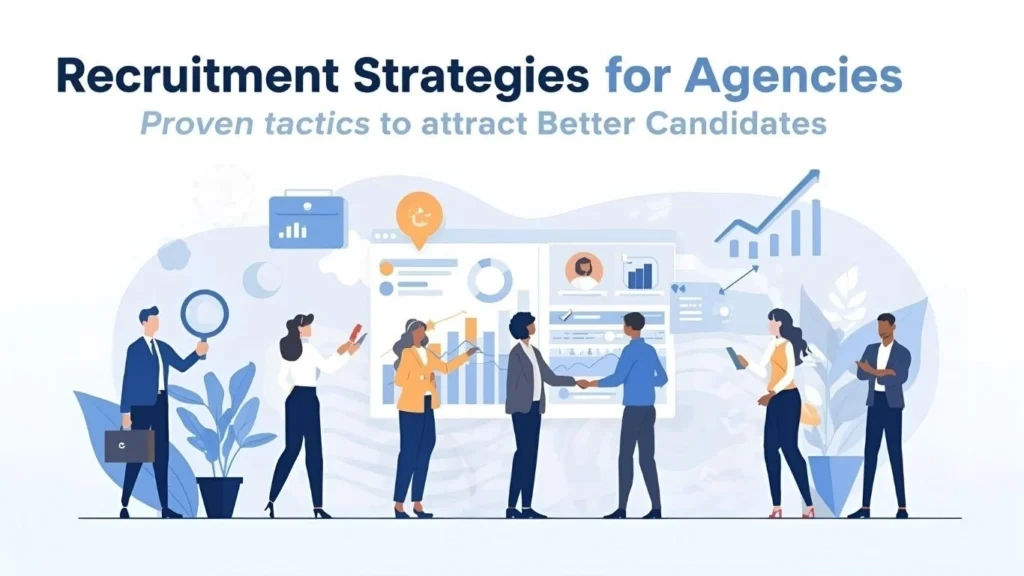
After careful analysis and elimination, we’ve put together the 5 most proven recruitment strategies for agencies to help your agency attract, engage, and hire better candidates. Faster and smarter.
Recruitment Strategies for Agencies That Improve Pipeline Quality
Recruitment strategies for agencies should solve two problems at once: finding enough qualified candidates and moving them through the client process without losing momentum. A strategy that only creates more resumes is not enough if client feedback, follow-ups, and submissions still live in scattered inboxes.
Start with the role types you fill most often, then build repeatable sourcing lists, outreach templates, screening scorecards, and client update rhythms around those roles.
| Agency challenge | Strategy to use | Tool or workflow to support it |
|---|---|---|
| Slow sourcing | Build reusable talent pools by niche | Candidate tags and saved searches |
| Weak candidate response | Personalize outreach by role and motivation | Email templates and sequences |
| Client feedback delays | Standardize shortlist submissions | Client portal and submission tracking |
| Unclear performance | Review source, stage, and placement data | Recruitment reporting dashboards |
Agencies that want a more repeatable process can connect sourcing, submissions, follow-ups, and client notes inside one recruitment CRM. For candidate-heavy desks, the applicant tracking system keeps every job pipeline structured.
Recruitment Agency Strategy by Growth Stage
The best recruitment strategy changes as an agency grows. A small agency needs focus and speed. A larger agency needs consistency, reporting, and process control across recruiters.
| Agency stage | Main risk | Strategy to prioritize |
|---|---|---|
| New agency | Trying to serve too many markets | Pick a niche and build repeatable candidate lists |
| Growing desk | Losing track of follow-ups | Standardize CRM stages, tasks, and outreach templates |
| Multi-recruiter team | Inconsistent candidate quality | Use scorecards, shared pipelines, and source reporting |
| Established agency | Growth depends on better margins | Improve client feedback speed and placement forecasting |
This is why recruitment strategy should not live only in a planning document. It needs to show up in the daily system recruiters use: saved searches, candidate tags, client notes, submissions, tasks, and reporting.
Metrics That Show Whether a Strategy Is Working
Recruitment strategies for agencies should be measured by pipeline movement, not only activity volume. More calls and more CVs are not useful if they do not improve candidate quality or client outcomes.
Track these metrics by role type, recruiter, source, and client:
| Metric | What it tells you |
|---|---|
| Qualified candidates per role | Whether sourcing is producing relevant profiles |
| Submission-to-interview rate | Whether shortlists match client expectations |
| Interview-to-offer rate | Whether screening and client alignment are strong |
| Offer acceptance rate | Whether compensation, timing, and candidate motivation are aligned |
| Time in stage | Where candidates or clients are slowing down |
| Source quality | Which channels produce candidates who actually progress |
Once you can see these patterns, strategy becomes easier to improve. You can double down on the sources, messages, and clients that move candidates forward instead of relying on guesswork.
What are recruitment strategies?
When it comes to finding the right talent, recruitment strategies for agencies play a huge role.
These strategies combine tried-and-tested methods with fresh, modern approaches to help attract, hire, and onboard the “right” candidates for your clients.
With a well-planned recruitment strategy in place, your hiring pipeline becomes more focused, efficient, and aligned, making it easier to connect clients with candidates who truly fit their needs.
Related Blog: 10 Best AI & ChatGPT Prompts Every Recruiter Should Be Using
What are the three most important recruitment principles?
Recruitment strategies for agencies have three most important recruitment principles that you just can’t skip:
Time, Cost, and Quality.
Think of them as the three pillars that hold your entire hiring process together.
1. Time matters because the faster you close a role, the happier your client, but of course, not at the cost of quality.
2. Cost comes next.
Smart budgeting in recruitment means getting the best results without burning through your resources.
3. And finally, Quality: the heart of every great hire.
Finding candidates who not only fit the role but also grow with the company makes all the difference.
When you strike the right balance between these three, your recruitment process becomes smoother, more strategic, and far more rewarding for both you and your clients.
Related Blog: 12 Best Recruitment CRM for Recruitment Agencies – Complete Guide
What are the 5 R’s of recruitment?
Recruitment strategies for agencies revolve around the 5 R’s of recruitment, which sum up everything you need to know to attract and hire better candidates effectively:
1. Right Person
It’s not just about a candidate having a resume that checks the boxes.
The right person is someone who aligns with your client’s culture, values, and long-term goals; someone who can thrive in the team and contribute meaningfully from day one.
2. Right Skills
Skills go beyond the basics.
The right candidate should have both the technical expertise and the soft skills needed to perform the role effectively, communicate well, and adapt to evolving client needs.
3. Right Job
Even the most talented candidate won’t succeed if the role doesn’t match their experience and career aspirations.
The right job ensures a perfect alignment between the candidate’s capabilities and the responsibilities they’ll take on.
4. Right Time
Timing can make or break recruitment success.
The right hire happens when both the candidate and the client are ready; when the role is open, the candidate is available, and the agency can facilitate a smooth process.
5. Right Cost
Efficiency matters.
The right cost means achieving all of the above without overspending on recruitment, ensuring that the client gets maximum value from every hire while keeping the process streamlined and sustainable.
Together, these 5 R’s of recruitment form the backbone of successful recruitment strategies for agencies!
Related Blog: The Ultimate Recruit CRM Showdown: Best ATS Ranked
What are the 7 basic elements of strategic planning?
Recruitment strategies for agencies work best when they’re built on these 7 basic elements of strategic planning:
1. Vision
Your vision is the big-picture direction for your agency — where you want to go and what you ultimately aim to achieve. It’s the guiding star that keeps every recruitment effort aligned.
2. Mission
Your mission explains why your agency exists and the impact you want to make for clients, candidates, and the industry. It’s the purpose behind every strategy and action you take.
3. Core Values
These are the principles that guide your agency’s culture, decisions, and interactions. Core values define how you work, treat candidates, and build relationships with clients.
Related Blog: 15 Free Job Posting Sites USA-Based Recruiters Can Use to Look for Diverse Talent
4. SWOT Analysis
A SWOT analysis gives you a clear picture of your agency’s strengths, weaknesses, opportunities, and threats. It helps you make smarter decisions and spot areas for growth before challenges arise.
5. Long-Term Goals
These are the big milestones that your agency is working toward over the next few years. They keep your team focused and provide direction for long-term success.
6. Yearly Objectives
Short-term targets that break down your long-term goals into actionable steps. They ensure progress is measurable and that your agency stays on track throughout the year.
7. Action Plans
These are the concrete steps that turn strategy into results. Action plans outline what needs to be done, who will do it, and when, making sure your recruitment goals are achieved efficiently.
Mastering these seven elements keeps your recruitment strategies focused, purposeful, and results-driven. No guesswork involved!
Related Blog: Best RecruiterFlow Alternatives for Small & Medium Recruiting Firms
Best recruitment strategies for agencies
Here are the 5 best recruitment strategies for agencies that can be used to attract better clients:
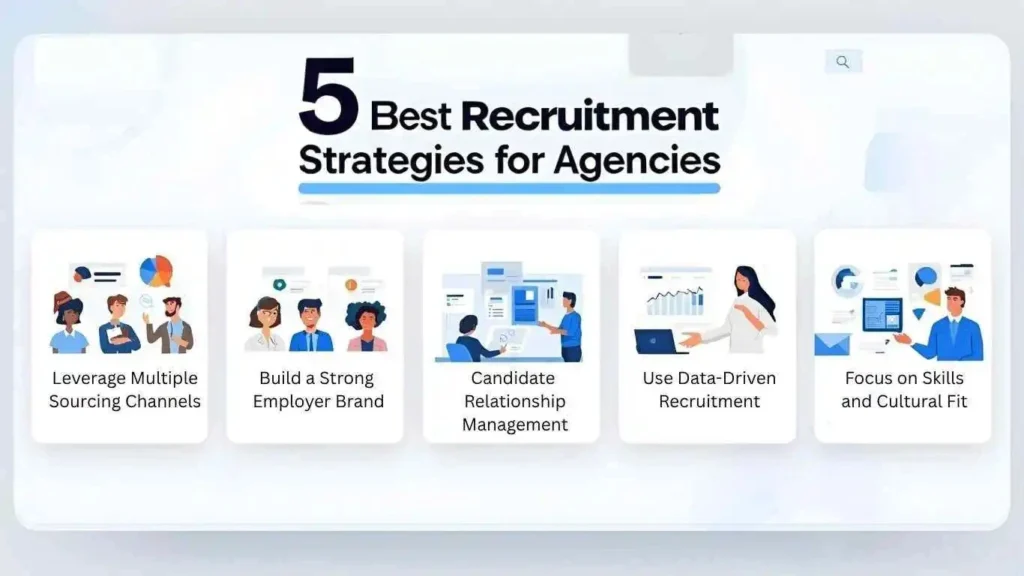
1. Leverage Multiple Sourcing Channels
Don’t put all your eggs in one basket. Use a mix of job portals, social media, LinkedIn, referrals, and industry networks to reach the widest possible talent pool.
The more channels you tap into, the higher the chances of finding that perfect candidate for your clients.
2. Build a Strong Employer Brand
Your clients aren’t just looking for candidates; they’re looking for candidates who are excited to join them. Highlight your clients’ culture, perks, and growth opportunities.
When candidates see the value and vision of the company, they’re far more likely to respond positively.
Related Blog: Discover 10 Free Most Powerful ATS for Small Businesses
3. Implement Candidate Relationship Management
Recruitment isn’t just about filling a role today; it’s about building relationships for the long haul.
Keep candidates engaged through personalized communication, regular follow-ups, and maintaining a talent pipeline. A little attention goes a long way in converting passive talent into successful hires.
4. Use Data-Driven Recruitment
Numbers don’t lie. Track metrics like time-to-hire, cost-per-hire, and candidate quality to understand what’s working and what needs improvement.
When your decisions are backed by data, you not only save time and resources but also increase your success rate with clients.
Related Blog: The Best Bullhorn Alternative for Effortless Hiring
5. Focus on Skills and Cultural Fit
Resumes tell a story, but they don’t tell the whole story. Always assess both the technical skills and cultural fit of a candidate.
When candidates align with the team and company culture, they’re more likely to perform well, stay longer, and truly add value.
When you bring together the recruitment principles, the 5 R’s of recruitment, and the 7 basic elements of strategic planning into the best recruitment strategies for agencies, you’re not just filling roles, but you’re building a recruitment process that’s focused, efficient, and delivers the right talent to your clients every time.
FAQs
1. What is strategic recruitment planning?
Strategic recruitment planning is all about hiring with a clear roadmap.
It means aligning your recruitment process with your agency’s goals, using data, planning ahead, and making sure every step brings you closer to finding the right talent efficiently.
2. What is a strategic planner in an agency?
A strategic planner in an agency is the person who maps out the recruitment roadmap.
They align hiring goals with client needs, plan each step carefully, and ensure the agency attracts and places the right talent efficiently.
3. What are the 7 steps of the recruitment process?
The 7 steps of the recruitment process guide agencies from start to finish:
identifying the need, creating a job description, sourcing candidates, screening applications, interviewing, selecting the right hire, and finally onboarding them smoothly.
4. What is a SWOT analysis for recruitment agency?
A SWOT analysis for a recruitment agency is a tool to evaluate its Strengths, Weaknesses, Opportunities, and Threats.
It helps the agency understand what’s working, identify areas to improve, spot growth opportunities, and prepare for challenges, making recruitment strategies smarter and more effective.