




Quick Answer
Contract staffing is a recruitment model where an agency supplies skilled workers to a client for a defined period, project, or long-term assignment. The agency helps source, screen, place, and manage contractors while earning revenue through margin, placement fees, or contract-to-hire conversion fees.
If you are asking, “How do you begin with contract staffing?”, the practical answer is: pick a niche, define your contract staffing model, create client and contractor agreements, build a vetted contractor pool, choose contract staffing software, set pay and bill rate rules, and start selling to companies with urgent skill gaps.
This playbook covers the contract staffing process, how agencies get staffing contracts, what features a staffing agency CRM needs in 2026, how to manage staffing agency contracts, and where software like ATZ CRM fits for agencies that want to scale contract and temporary staffing without living in spreadsheets.
What Is Contract Staffing in Recruitment?
Contract staffing in recruitment is the process of placing workers into roles for a specific period, project, or business need rather than a permanent employee role. The contractor may work for a few weeks, several months, or multiple years depending on the arrangement.
Contract staffing is common in:
- IT and software development
- Salesforce and CRM implementation
- Engineering
- Finance and accounting
- Healthcare
- Life sciences
- Construction and skilled trades
- Blue collar staffing
- Call center and customer support
- Professional services
- Project management
- Manufacturing and logistics
The core idea is simple: the client needs skilled work done, but does not always want to hire a permanent employee. The agency supplies the contractor, manages the recruitment process, and may also support compliance, timesheets, payroll coordination, assignment tracking, and renewals.
Contract staffing overlaps with temporary staffing, staff augmentation, and contract-to-hire. The exact structure depends on who employs the worker, how the worker is paid, how long the assignment lasts, and whether the client may convert the contractor to a permanent employee.
Contract Staffing Model: How Agencies Make Money
The contract staffing model usually creates recurring revenue for the agency. Instead of earning only a one-time permanent placement fee, the agency earns money while the contractor remains active on assignment.
Common revenue models include:
| Model | How it works | Best fit |
|---|---|---|
| Pay/bill margin | Agency pays the contractor and bills the client at a higher rate | Temporary, contract, and long-term assignments |
| Contract placement fee | Client pays a fee for the agency to find a fixed-term contractor | Direct contractor hiring or fixed-term roles |
| Contract-to-hire conversion fee | Client pays a fee if the contractor becomes permanent | Trial-to-hire or temp-to-perm roles |
| Managed staffing service | Agency manages multiple contractors or a workforce program | Larger clients and strategic staffing contracts |
| Statement of work support | Agency supplies talent for a defined project outcome | Project-based professional services |
For example, if a contractor is paid $60 per hour and the client is billed $78 per hour, the agency’s gross spread is $18 per hour before taxes, insurance, payroll costs, vendor fees, and overhead. The margin must be priced carefully because contract staffing agencies often pay workers before clients pay invoices.
That cash-flow gap is one of the first operational realities new agencies need to understand. Contract staffing can be profitable, but it requires disciplined billing, collections, payroll planning, and contract management.
How Do You Begin With Contract Staffing?
Starting contract staffing is less about “finding any contractor” and more about building a repeatable service line. Here is a practical roadmap.

1. Choose a Contract Staffing Niche
Start with one market where you understand the roles, buyer pain, pay rates, and compliance expectations. A generalist contract staffing agency can work later, but a narrow niche is easier to sell at the beginning.
Strong niches include tech contracting, Salesforce contractors, healthcare contract roles, engineering contractors, finance contractors, blue collar contract staffing, call center contract staffing, and project-based professional services.
2. Define the Service Model
Decide what you are offering:
- Contract staffing
- Contract-to-hire
- Staff augmentation
- Long-term contractor placements
- Temporary-to-contract staffing
- Remote contract staffing
- Project-based staffing
This matters because the client agreement, pricing, payroll workflow, candidate screening, and contractor support model will differ by service type.
3. Create Client and Contractor Agreements
You need contracts for staffing agency operations before you make placements. At minimum, prepare a client staffing agreement and a contractor or worker agreement. Have legal counsel adapt templates for your jurisdiction and niche.
The client agreement should define pay and bill rates, payment terms, invoicing rules, overtime, conversion fees, replacement rules, background checks, confidentiality, liability, insurance, assignment changes, and termination terms.
The contractor agreement should define role scope, rate, payment timing, assignment dates, confidentiality, work expectations, timesheet rules, equipment, notice terms, and compliance requirements.
4. Build a Contractor Talent Pool
Contract staffing recruiters need ready talent. Start building a database before clients ask for urgent contractors. Segment people by skill, location, rate, availability, work authorization, certifications, industries, and past performance.
If you want to hire Salesforce contractors, for example, tag candidates by Salesforce Cloud, certifications, implementation experience, admin vs developer vs architect level, hourly rate, remote preference, and availability.
5. Set Pricing and Margin Rules
Know your burden before quoting clients. Your margin must cover payroll taxes, insurance, workers’ compensation where relevant, payroll provider costs, background checks, software, recruiter time, and profit.
Do not let the client negotiate only on markup. Explain the full service: sourcing, screening, compliance, contractor care, replacement support, and assignment management.
6. Choose Contract Staffing Software
Spreadsheets can help you start, but they break quickly once you manage multiple clients, contractors, contract terms, submissions, placements, timesheets, renewals, and follow-ups. Choose staffing agency CRM software that keeps client and contractor activity together.
7. Sell a Specific Outcome
Clients do not buy “contract staffing” in the abstract. They buy faster project delivery, lower vacancy risk, specialized skills, reliable workforce coverage, or a way to avoid permanent headcount until the need is proven.
Your pitch should speak to the problem: “We help Salesforce teams add vetted contractors within days,” or “We help call centers cover seasonal demand without adding permanent headcount.”
The Contract Staffing Process Step by Step
A repeatable contract staffing process protects margin and improves client experience.
1. Client Requirement Intake
Capture the role, project, duration, start date, location, remote/hybrid expectations, rate range, must-have skills, nice-to-have skills, compliance requirements, interview process, equipment expectations, approval contact, and conversion terms.
2. Talent Search
Search your CRM, previous contractors, referrals, job boards, LinkedIn, niche communities, and outreach lists. Contract staffing recruiters should prioritize people who are available, qualified, and interested in contract work.
3. Screening and Qualification
Screen for skill fit, project experience, rate expectations, availability, work authorization, location, communication style, reliability, and contract motivation. For regulated industries, add credentialing, background checks, drug screening, or license verification where needed.
4. Submission and Client Review
Submit a focused shortlist. A good contractor submission should include skills, project relevance, availability, rate, location, work authorization status where appropriate, and any risks that could affect the start.
5. Interview and Selection
Contract interviews should move quickly. Long processes cause contractors to accept other work. Agree on the interview process with the client before sourcing begins.
6. Contract, Onboarding, and Start
Confirm client terms, contractor terms, start date, timesheet process, reporting contact, equipment, system access, confidentiality, and compliance items before the contractor starts.
7. Timesheets, Invoicing, and Assignment Management
Once active, track timesheets, approvals, assignment feedback, extension dates, issues, and client satisfaction. Contract staffing services are ongoing; the agency’s work does not stop when the contractor starts.
8. Renewal, Conversion, or Offboarding
Before the contract ends, confirm whether the client wants an extension, conversion to permanent, replacement, or offboarding. Record feedback and update the contractor’s availability for the next assignment.
How Staffing Agencies Get Contracts
Your GSC data shows several versions of this question: “how to get contracts for staffing agency,” “how do staffing agencies get contracts,” and “contracts for staffing agency.” This is high-intent business development content, so the answer needs to be practical.
Staffing agencies get contracts by proving they can solve a specific workforce problem better than the client can solve it alone.
Pick a Narrow Buyer List
Do not start with “any company that hires.” Build a list of companies that actually use contractors: SaaS companies hiring implementation talent, hospitals using travel or contract clinicians, manufacturers needing skilled trades, call centers scaling seasonal teams, or IT consultancies needing project support.
Lead With a Talent Advantage
Clients respond when you can show access to people they cannot easily find. Share market insight, availability data, salary/rate ranges, and examples of roles you can fill quickly.
Build Relationships Before Requisitions
Staffing contracts rarely appear after one cold email. Build a cadence across LinkedIn, email, phone, referrals, local events, niche communities, and hiring manager education.
Offer a Low-Risk First Engagement
For a new client, make the first contract easy to test. Keep the role narrow, terms clear, and communication tight. A successful first placement can turn into a master service agreement or repeat contract staffing program.
Prepare Your Paperwork
Many agencies lose momentum because the client is interested but the agency is not ready with terms. Have your service agreement, insurance information, rate card logic, compliance checklist, and onboarding process ready.
Track Every Sales Touch in Your CRM
Contract staffing is a relationship business. Track hiring managers, HR contacts, procurement contacts, previous conversations, open roles, objections, contract terms, and follow-ups. If your client development lives only in inboxes, the pipeline will leak.
Strategic Staffing Contracts: What to Include
Strategic staffing contracts protect both the agency and the client. They also prevent confusion when a contractor performs well and the client wants to extend, convert, or change the role.
Key terms to define:
- Scope of services
- Role types covered
- Pay rate and bill rate structure
- Markup or margin method
- Payment terms
- Timesheet and approval rules
- Overtime rules
- Background checks and credentialing
- Insurance requirements
- Worker classification responsibilities
- Confidentiality and data handling
- Non-solicitation and conversion fees
- Replacement guarantees where offered
- Early termination rules
- Extension and renewal process
- Dispute resolution
Agencies should avoid vague contract language around conversion. If the client hires the contractor permanently, the fee or conversion formula should already be defined.
How to Manage Staffing Agency Contracts
Managing contracts is not only a legal task. It is an operational workflow. Recruiters, account managers, finance, compliance, and leadership all need visibility.
A staffing agency should track:
- Client agreement status
- Contractor agreement status
- Assignment start and end dates
- Pay rate and bill rate
- Timesheet rules
- Invoice frequency
- Payment terms
- Compliance documents
- Renewal dates
- Conversion clauses
- Insurance requirements
- Hiring manager approvals
- Contract owner
If you are searching “manage contracts in Bullhorn,” the broader lesson is that contract data needs to live where recruiters and account managers already work. Whether you use Bullhorn, ATZ CRM, or another staffing platform, contract terms should connect to clients, candidates, jobs, placements, tasks, and reporting.
Contract Staffing Software: What It Should Do
Contract staffing software helps agencies manage the moving parts of contract recruitment. It is more than an applicant tracking system and more than a generic CRM.
At minimum, contract staffing software should support:
- Client and hiring manager records
- Contractor profiles and talent pools
- Job order tracking
- Candidate search and filtering
- Availability and rate tracking
- Outreach and follow-up workflows
- Submission tracking
- Placement and assignment records
- Contract start and end dates
- Renewal reminders
- Compliance document tracking
- Timesheet-related workflows
- Billing and invoicing visibility
- Reporting by client, recruiter, source, margin, and role
For contract staffing agencies, the most important thing is connection. Candidate activity, client demand, contract terms, placement status, and follow-up should not live in separate systems.
Essential Features of Staffing Agency CRM in 2025 and 2026
Your query data includes “essential features of staffing agency CRM 2025 or 2026,” which is a strong signal that readers are evaluating software. Here is the practical feature checklist.
| CRM feature | Why it matters for contract staffing |
|---|---|
| Client relationship management | Tracks hiring managers, HR contacts, procurement, conversations, and open demand |
| Contractor database | Stores skills, rate, availability, location, documents, and placement history |
| Pipeline management | Shows every contractor and job through sourcing, submission, interview, offer, placement, and extension |
| AI matching | Helps recruiters shortlist contractors by skills, history, and job fit |
| Bulk outreach | Speeds up contractor activation for urgent roles |
| Compliance tracking | Reduces risk from missing documents, credentials, or checks |
| Contract and placement tracking | Connects agreement terms to live assignments |
| Timesheet visibility | Helps recruiters and operations teams track approval status and issues |
| Automation | Handles reminders, follow-ups, re-engagement, renewal alerts, and candidate nurturing |
| Reporting | Shows fill rate, time to submit, contractor utilization, source performance, and revenue signals |
| Integrations | Connects job boards, email, calendar, payroll, background checks, and back-office tools |
ATZ CRM supports agencies that need candidate management and client CRM in one workspace. For contract staffing recruiters, that means less context switching between business development, job orders, contractor outreach, submissions, placements, and follow-up.
Top Staffing Platforms for Contract and Temporary Workers in 2025 and 2026
Many readers searching this topic are comparing platforms, but the best choice depends on the agency model.
Common categories include:
- ATS and CRM platforms for staffing agencies
- Contract staffing software with placement workflows
- Back-office platforms for payroll, billing, and invoicing
- Workforce management tools for shift or hourly workers
- Sourcing tools for finding contractors
- AI screening and interview intelligence tools
- Vendor management or MSP systems for enterprise staffing programs
When evaluating platforms for contract and temporary workers, look for these decision points:
- Does the system manage both candidates and clients?
- Can it handle contract, temporary, and permanent pipelines?
- Does it track availability, rates, start dates, and end dates?
- Can recruiters manage outreach from the same place?
- Can managers see job orders, submissions, placements, and revenue signals?
- Does it support compliance and document reminders?
- Does it integrate with payroll, accounting, calendar, email, and job boards?
- Is it simple enough for recruiters to use every day?
Platforms such as ATZ CRM, Bullhorn, Recruiterflow, Recruit CRM, JobAdder, Vincere, Loxo, Tracker RMS, Zoho Recruit, and others are commonly evaluated by staffing agencies. The right system depends on team size, back-office needs, contract volume, budget, and whether the agency needs one tool for both candidate and client workflows.
Contract Staffing Services Market and Trends
Contract staffing remains important because employers want flexible access to skills without committing every need to permanent headcount. The American Staffing Association reports that staffing companies hired millions of temporary and contract employees in the US during 2023, which shows how large the flexible workforce already is.
Key contract staffing trends for 2026 include:
- More demand for specialist contractors in IT, AI, cybersecurity, healthcare, engineering, and finance
- Higher expectations for speed and contractor quality
- Growth in contract-to-hire for risk-controlled hiring
- More remote and hybrid contract roles
- More client scrutiny of compliance and worker classification
- More use of AI matching and automation by contract staffing recruiters
- More pressure to connect recruiting, CRM, and back-office workflows
Contract AI staffing solutions are also becoming more common. AI can help with matching, outreach, screening summaries, candidate notes, and database rediscovery. The agency still needs human judgment, especially for client trust, compliance, and contractor relationships.
Contract Staffing Recruiters: What Changes Day to Day?
Contract staffing recruiters work differently from permanent recruiters. They still need sourcing and closing skills, but they also need faster availability checks and stronger operational follow-up.
Contract staffing recruiters usually manage:
- Contractor availability
- Rate negotiation
- Quick submission deadlines
- Client interview coordination
- Assignment start details
- Timesheet questions
- Extension conversations
- Contractor care
- Redeployment after contract completion
The best contract staffing recruiters know their talent market deeply. They understand who is available, who is finishing an assignment soon, who prefers remote contract work, who is open to contract-to-hire, and who is likely to accept a long-term contract.
Contract-to-Hire and Long-Term Contracts
Contract-to-hire agencies help clients test a worker before making a permanent offer. This model can reduce hiring risk for clients and create multiple revenue opportunities for agencies.
Long-term contracts are different. A contractor may stay on assignment for six months, one year, or longer without any intent to convert. This is common in IT, engineering, healthcare, and project-based work.
For both models, the contract must define:
- Conversion fee or conversion period
- Minimum contract duration
- Notice period
- Extension terms
- Pay and bill rate changes
- Benefits or eligibility rules where relevant
- Client communication responsibilities
Contract-to-hire and long-term contracts can be excellent for agencies, but only when terms are clear from the beginning.
Agency vs Contractor vs Staff Augmentation
Some GSC queries are broader, such as “agency vs contractor,” “contract worker,” “contract staff,” “what are contractor jobs,” and “what is staff augmentation.” This page can serve those readers with quick clarity.
| Term | Meaning |
|---|---|
| Contractor | A worker engaged for a defined project, period, or service arrangement |
| Contract staff | Contractors supplied to a business by an agency or staffing provider |
| Contract position | A job with a defined contract period or project scope |
| Staff augmentation | Adding external workers to a client’s team to fill skill or capacity gaps |
| Contract staffing agency | An agency that recruits and supplies contractors to client companies |
| Contract-to-hire agency | An agency that supplies workers who may later convert to permanent employees |
Staff augmentation is often used in technology and professional services. The contractor joins the client’s team to add capacity or skill, but the engagement is still flexible and time-bound.
Common Contract Staffing Mistakes
Avoid these mistakes when building or scaling contract staffing:
- Starting without clear client and contractor agreements
- Pricing only on competitor markup instead of true cost and risk
- Ignoring cash-flow gaps between payroll and client payment
- Letting contract end dates pass without extension conversations
- Using a generic CRM that does not track placements or assignments
- Failing to document client requirements and approval rules
- Treating contractor care as optional after start date
- Building a database without availability and rate data
- Selling resumes instead of business outcomes
- Waiting for clients to ask before building contractor talent pools
Contract staffing rewards discipline. Fast placement matters, but fast placement without process creates margin leaks.
Where ATZ CRM Fits
ATZ CRM gives recruitment agencies a connected workspace for candidates, clients, jobs, outreach, pipelines, submissions, placements, and reporting. For contract staffing, that connected view matters because the agency is managing both sales and delivery at the same time.
With ATZ CRM, agencies can organize contractor records, manage client relationships, track job orders, run outreach, monitor pipelines, and keep placement activity visible across the team. Agencies that handle contract, temporary, and permanent roles can use one system instead of splitting candidate history across multiple tools.
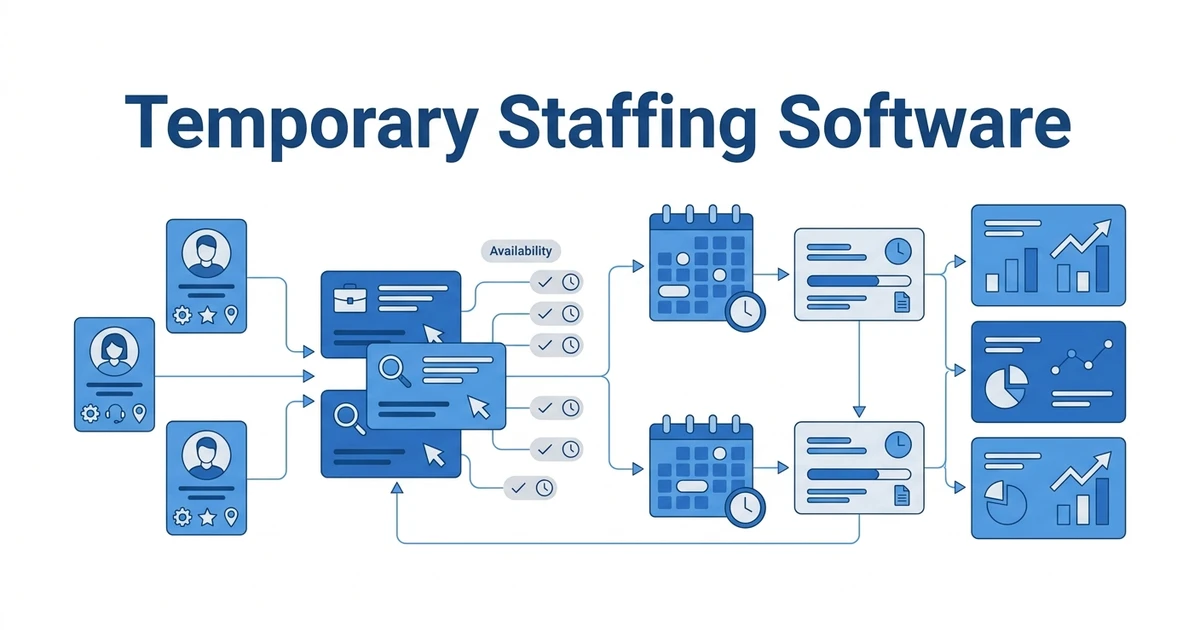
For related workflows, explore contract staffing software, temporary staffing software, and permanent placement software.
Conclusion
Contract staffing is one of the most practical ways for recruitment agencies to build recurring revenue, deepen client relationships, and serve companies that need flexible access to skilled talent. But the model is not just “permanent recruitment with a different contract.” It has its own process, contracts, pricing, compliance, cash-flow realities, and software requirements.
To begin with contract staffing, choose a niche, define your service model, prepare client and contractor agreements, build a contractor talent pool, set rate and margin rules, and use contract staffing software that connects clients, contractors, jobs, placements, and follow-up.
Agencies that win in 2026 will not only find candidates. They will manage contract staffing like an operating system: clear sales process, reliable contractor pipeline, strong client agreements, visible assignment management, and CRM data that helps recruiters move faster without losing control.
Ready to build a cleaner contract staffing workflow? Request a demo and see how ATZ CRM helps agencies manage candidates, clients, jobs, and placements in one place.
FAQs
How do you begin with contract staffing?
Begin with contract staffing by choosing a niche, defining your service model, preparing contracts, setting pricing and margin rules, building a contractor pool, choosing staffing agency CRM software, and selling a clear business outcome to clients.
What is contract staffing in recruitment?
Contract staffing in recruitment means placing workers with client companies for a defined project, period, or long-term assignment rather than a permanent role. The agency manages recruitment and may also support compliance, payroll coordination, timesheets, and contractor care.
What is contract staffing software?
Contract staffing software helps agencies manage clients, contractors, job orders, submissions, placements, contract terms, assignment dates, compliance documents, renewals, timesheets, billing visibility, and reporting.
What are the essential features of staffing agency CRM in 2026?
Essential staffing agency CRM features include client CRM, contractor search, pipeline tracking, AI matching, outreach automation, compliance reminders, contract tracking, placement management, timesheet visibility, integrations, and reporting.
How do staffing agencies get contracts?
Staffing agencies get contracts by choosing a niche, building target account lists, proving access to qualified talent, networking with hiring managers, running outbound sales, preparing clear contract terms, and delivering reliable first placements.
How do you manage staffing agency contracts?
Manage staffing agency contracts by storing client terms, contractor agreements, pay and bill rates, start and end dates, conversion clauses, renewal reminders, compliance documents, and timesheet rules in a central ATS and CRM.
What is contract-to-hire?
Contract-to-hire is when a contractor starts on assignment and may later convert into a permanent employee. The agency usually defines the conversion period and fee in the client agreement.