


Quick Answer
The best temporary staffing software for startups in 2026 is the tool that helps a small agency manage candidates, clients, temporary job orders, availability, outreach, submissions, placements, timesheets, payroll handoff, invoicing context, and follow-ups without adding heavy admin cost.
If you are just starting, you can combine free tools such as Google Sheets, free job boards, Calendly, email, and a lightweight CRM. But once you are managing multiple clients, active temp workers, contract assignments, or recurring job orders, you need a proper staffing ATS and CRM. That is where platforms like ATZ CRM become more useful than a patchwork of free apps.
For most startups, the right path is:
- Start lean with free tools while validating your staffing niche.
- Move to dedicated staffing software when candidate, client, and placement data becomes hard to manage.
- Prioritize CRM, candidate search, availability tracking, timesheet visibility, automation, and reporting before paying for complex enterprise features.
Which Temporary Staffing Tool Do You Need?
Searches like “temporary staffing software,” “temp staffing software,” “temporary recruitment agency software,” and “free CRM tools for temp agencies personnel services” are close, but they reveal different buying needs. Use this table before comparing tools.
| Search intent | What the buyer usually needs | Best starting point |
|---|---|---|
| Temporary staffing software | A system for temp job orders, candidates, availability, placements, shifts, timesheets, and reporting | Staffing ATS + CRM with temp workflow support |
| Temp staffing agency software | Agency software for clients, candidates, submissions, placements, recruiter activity, and repeat temp orders | Recruitment CRM plus applicant tracking |
| Temporary recruitment agency software | Candidate and client workflow for agencies that place temporary or contract workers | ATS + CRM, not a generic employer ATS |
| Temporary staff management software | Operational visibility across workers, assignments, availability, documents, and time-related workflows | Staffing software plus timesheet or workforce management integration |
| Contract staffing software | Contractor records, assignment terms, renewals, compliance reminders, timesheet context, and billing handoff | Contract staffing workflow inside or connected to the staffing platform |
| Free CRM for temporary staffing and personnel services | Contact management, candidate history, client follow-up, reminders, and early-stage pipeline organization | Free trial or lightweight CRM, then upgrade as placements increase |
| Staffing tools | A broader toolkit covering sourcing, outreach, scheduling, CRM, ATS, payroll, reporting, and communications | Build a lean stack, then consolidate around the daily system of record |
Your software choice depends on the workflow you need to run, not only the category name.
Temporary staffing agencies usually need to manage:
- Client companies and hiring contacts
- Temporary job orders
- Candidate applications and resumes
- Candidate availability
- Shift or assignment details
- Shortlists and submissions
- Placement status
- Timesheet-related tasks
- Payroll and invoicing handoff
- Compliance documents
- Candidate redeployment
- Client reporting
Free tools can help in the first stage, but they rarely cover the full temporary workforce management workflow. The more active workers, clients, and placements you manage, the more expensive manual tracking becomes.
What Is Temporary Staffing Software?
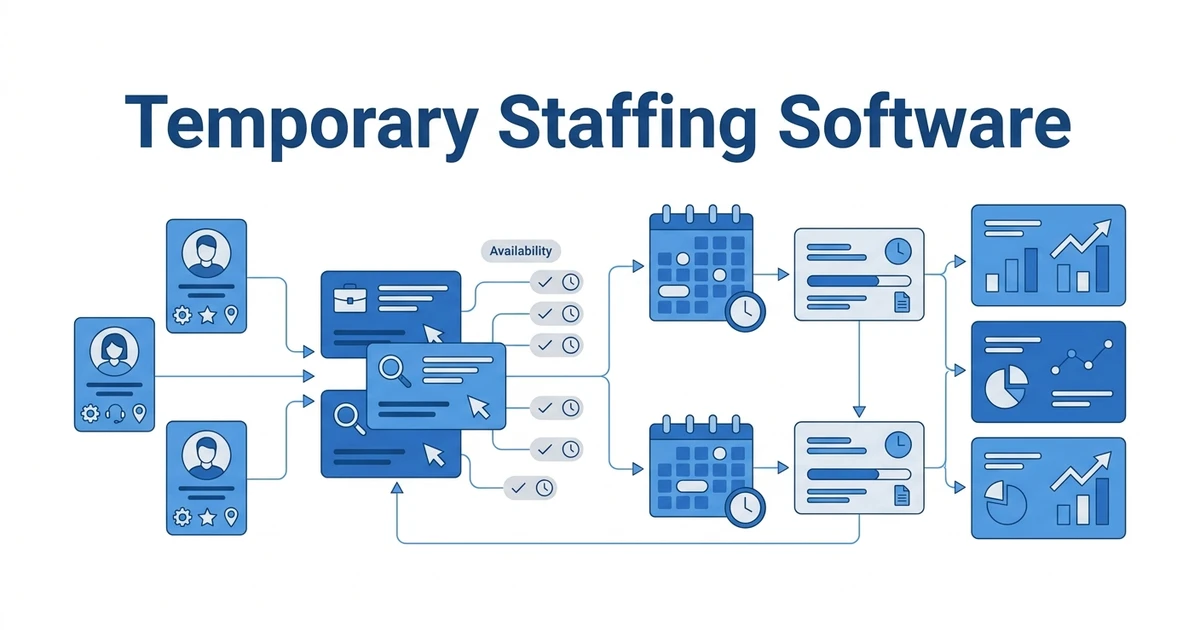
Temporary staffing software is a system that helps staffing agencies manage short-term, contract, temp-to-hire, and temporary workforce recruitment workflows. It is more specialized than a basic applicant tracking system because temp staffing does not end when a candidate is submitted.
A good temporary staffing management system should support the full cycle:
- A client opens a temporary job order.
- Recruiters search available candidates.
- Candidates are screened and contacted.
- Suitable workers are submitted to the client.
- The client accepts one or more workers.
- The agency confirms start details, assignment dates, and requirements.
- Timesheets, attendance, feedback, extensions, and redeployment are tracked.
That is why many buyers search for terms like “temporary staff management software,” “temporary workforce CRM,” “temp staffing invoicing software,” and “temporary staffing timesheet software.” They need more than resume storage. They need workflow control.
For agencies that want a deeper workflow view, ATZ CRM also has a dedicated temporary staffing software page and an ATS for temporary staffing page.
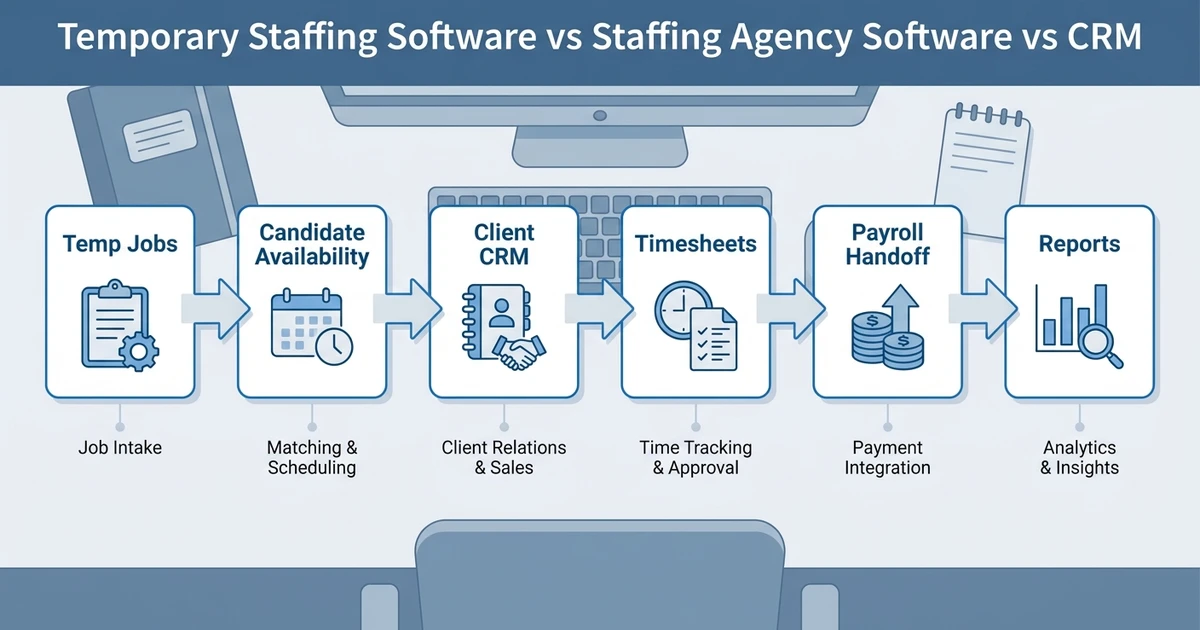
Temporary Staffing Software vs Staffing Agency Software vs CRM
These terms overlap, but they are not identical.
| Term | What it usually means | Best for |
|---|---|---|
| Temporary staffing software | Tools for temp job orders, candidates, placements, assignments, shifts, timesheets, and workforce tracking | Temp agencies and contract staffing teams |
| Staffing agency software | Broader agency software for permanent, contract, and temporary recruitment | Agencies offering multiple recruitment services |
| Temporary workforce CRM | CRM layer for managing client contacts, candidate relationships, outreach, and redeployment | Agencies that need relationship and follow-up visibility |
| Recruitment agency software | ATS and CRM tools for sourcing, screening, submissions, and placements | Recruitment firms of all types |
| Staffing payroll software | Payroll, tax, timekeeping, and pay/bill workflows | Agencies with active payroll responsibility |
For a startup staffing agency, the best choice is usually not the most complex platform. It is the tool that supports your current workflow while leaving room to grow.
Best Temporary Staffing Software Options for Startups
Below is a practical comparison of free, affordable, and scalable options for temporary staffing agencies. Some are full staffing platforms. Others are useful pieces of a startup software stack.
| Tool or category | Best use case | Free or affordable angle | Watch out for |
|---|---|---|---|
| ATZ CRM | Startup and growing agencies needing ATS + CRM workflows | Unlimited free trial and agency-focused setup | Dedicated payroll/back-office needs may require integrations |
| Google Sheets | Very early validation and simple tracking | Free and flexible | Breaks down with multiple recruiters, clients, and placements |
| Airtable or Notion | Lightweight custom database for early teams | Free or low-cost entry plans | Requires manual setup and process discipline |
| Zoho Recruit | Small teams needing ATS basics | Freemium/entry-level options available depending on plan | Temp-specific workflows may need configuration |
| Open-source ATS/CRM tools | Self-hosted or technical teams | No license cost for some tools | Setup, hosting, security, and maintenance are on you |
| Free job boards | Candidate acquisition | Free posting options | Does not solve CRM, timesheets, or placement management |
| Calendly or scheduling tools | Interview scheduling | Free or low-cost plans | Only solves scheduling |
| Timesheet/payroll tools | Hours, pay, and billing workflows | Some low-cost tools exist | Often separate from ATS/CRM unless integrated |
| Enterprise staffing suites | Large temp, contract, and pay/bill operations | Deep capabilities | May be too expensive or heavy for startups |
For a startup, the strongest setup is often not one tool at first. It is a small stack:
- ATS + CRM for candidate and client management
- Free job boards for sourcing
- Calendar scheduling for interviews
- Email and automation for follow-up
- Timesheet/payroll tool when assignments become active
- Reporting to understand source, recruiter, and client performance
The goal is not to buy every staffing tool on day one. The goal is to make sure the system of record is clean before temp orders, candidate availability, and client follow-up become too fast to manage manually.
Free Staffing Agency Software: What You Can Do for $0
Free staffing agency software can work when your agency is still small. If you have one recruiter, a few clients, and a limited number of active candidates, free tools can help you validate demand before committing to a paid platform.
With free or low-cost tools, you can usually manage:
- Basic candidate lists
- Simple resume tracking
- Client contact lists
- Job order notes
- Manual status tracking
- Interview scheduling
- Basic email follow-up
- Simple reporting using spreadsheets
This is enough for the first stage of a staffing startup. It is not enough forever.
Free tools become risky when:
- Multiple recruiters work the same database.
- Candidates are contacted twice.
- Client requirements are buried in messages.
- Temporary job orders move quickly.
- You need to track availability.
- Timesheets and invoices matter.
- You need candidate redeployment.
- Managers need real reporting.
- Compliance documents are scattered.
The right question is not “Can I start for free?” You can. The better question is “At what point do free tools start costing us placements?”
Free CRM for Temporary Staffing and Personnel Services
Several GSC queries are about free CRM tools for temp agencies, staffing agencies, personnel services, and recruitment agencies. That tells us buyers are not only looking for ATS features. They want relationship management.
A temporary staffing CRM should help you track:
- Client companies
- Hiring managers
- HR and procurement contacts
- Candidate conversations
- Outreach history
- Follow-up reminders
- Open job orders
- Candidate availability
- Submissions
- Placement notes
- Assignment end dates
- Redeployment opportunities
Free CRMs can help with basic contact management, but most generic CRMs do not understand recruitment workflows. They may track contacts well, but they usually do not handle candidate submissions, job pipelines, temporary placements, or staffing-specific reporting without heavy customization.
If you are evaluating a free CRM for staffing agencies, ask:
- Can it manage candidates and clients in one system?
- Can it track job orders?
- Can it store candidate availability?
- Can it show which candidates were submitted to which client?
- Can it track placement status?
- Can it remind recruiters about assignment end dates?
- Can it handle tags for skills, locations, shifts, and certifications?
- Can it produce recruiter and client reports?
If the answer is no, it may be fine for a contact list, but it is not really temporary staffing software.
For a personnel services startup, a free CRM should be treated as a starting point, not the whole operating system. It can help you remember who to call. It usually cannot show the complete staffing picture: which client requested which worker, who was submitted, who accepted, which assignment is ending, and which candidate should be redeployed next.
Temporary Recruitment Agency Software for Startup Teams
Temporary recruitment agency software should support the day-to-day work of recruiters, not only the back-office work that happens after a worker starts. In a startup agency, the same person may sell to clients, source candidates, submit shortlists, confirm assignment details, and chase follow-ups.
That means the core system should make these actions easy:
- Add a new client and temporary job order quickly.
- Search candidates by skills, tags, location, availability, and previous placement history.
- Move candidates through screening, shortlist, submission, interview, placement, and redeployment stages.
- Keep every client and candidate message visible to the team.
- Track temporary assignment dates, end dates, and next actions.
- Report which sources, recruiters, and clients are producing placements.
Generic recruitment software may handle applicants well but miss the client-side workflow. Generic CRM software may handle sales contacts well but miss submissions and placements. Temporary recruitment agency software needs both.
Temp Staff Management Software: When Operations Matter More
“Temp staff management software” usually signals a more operational need. The buyer may already have active workers and now needs tighter visibility across shifts, assignment changes, timesheets, payroll handoff, and client communication.
Look for these capabilities once active placements begin:
- Worker availability and assignment status
- Start dates, end dates, shift patterns, and location details
- Timesheet submission and approval visibility
- Pay rate, bill rate, and payroll or invoicing handoff fields
- Compliance document reminders
- Client feedback and extension tracking
- Redeployment lists for workers ending soon
If payroll, tax, or complex pay/bill processing is the main pain, you may need a dedicated payroll or back-office staffing system connected to your ATS and CRM. If the main pain is sales, recruiting, submissions, placements, and visibility, start with agency-focused staffing software.
Features That Matter Most in Temporary Staffing Software
Temporary staffing is fast, operational, and relationship-heavy. The software should support those realities.
Candidate Database and Search
Recruiters need to search by skills, location, availability, shift preference, pay expectation, certifications, experience, source, and work history. A basic resume folder is not enough.
Client CRM
Temporary recruitment agency software should track companies, hiring contacts, job order history, communication, terms, feedback, and follow-ups.
Temporary Job Order Tracking
A temp job order needs more detail than a permanent role. Track start date, assignment length, shift, location, pay rate, bill rate, required documents, client contact, hiring manager notes, urgency, and the number of workers required.
Availability Tracking
For temporary staffing, availability is often the difference between a placement and a dead lead. The system should make it easy to identify who can start soon.
Bulk Outreach
Temp staffing agencies often need to contact several suitable candidates quickly. Email, SMS, or campaign tools help activate candidates without manual one-by-one messages.
Submission and Placement Management
Recruiters should know who was submitted, when they were submitted, what the client said, and whether the candidate moved into placement.
Timesheet Visibility
Temporary staffing timesheet software or integrations matter once workers are active. Even if payroll is handled elsewhere, recruiters and operations teams need visibility into timesheet status.
Payroll and Invoicing Handoff
Temp staffing payroll software is its own category, but your recruiting system should at least connect placement, assignment, pay, bill, and client data cleanly.
Compliance Tracking
Track right-to-work or work authorization, certifications, background checks, licenses, safety documents, and renewal reminders where relevant.
Reporting
Startups should track fill rate, time to submit, time to fill, source of placed candidates, recruiter activity, client order volume, and redeployment.
Temporary Staffing Software Feature Checklist
Use this checklist when comparing temporary staffing software, temp staffing agency software, or contract staffing software.
| Feature | Why it matters for temporary staffing startups |
|---|---|
| Candidate database | Keeps resumes, skills, locations, preferences, and history searchable |
| Client CRM | Tracks companies, contacts, conversations, open orders, terms, and feedback |
| Job order pipeline | Shows every temporary requirement from intake to filled |
| Availability fields | Helps recruiters find candidates who can start soon |
| Tags and segmentation | Supports searches by skills, certifications, location, shift, source, or redeployability |
| Outreach automation | Speeds up candidate activation and client follow-up |
| Submission tracking | Prevents confusion over who was sent to which client |
| Placement management | Connects starts, assignment dates, status, notes, and recruiter ownership |
| Timesheet visibility | Keeps recruiters aware of active worker and approval status |
| Payroll and invoicing handoff | Reduces manual copy-paste between recruiting and finance workflows |
| Compliance reminders | Helps prevent missing or expired documents |
| Reporting | Shows fill rate, time to fill, recruiter activity, client performance, and sources |
Best Free or Affordable Stack by Agency Stage
The right stack changes as your agency grows.
| Agency stage | Recommended setup | Why it works |
|---|---|---|
| Solo founder validating a niche | Spreadsheet, free job boards, calendar tool, email, lightweight CRM | Keeps cost low while testing demand |
| First recurring clients | ATS + CRM, structured job orders, candidate tags, email automation | Prevents candidate and client data from scattering |
| Active temp placements | ATS + CRM, timesheet workflow, payroll or invoicing handoff, reporting | Supports actual assignment management |
| Growing team | Shared recruitment CRM, role-based permissions, automation, client reporting | Reduces duplicate work and improves visibility |
| Multi-location or high-volume agency | Integrated staffing platform, payroll/back-office tools, compliance, analytics | Handles scale and operational risk |
This staged approach is important for startups. Buying enterprise temporary staffing software too early can waste budget. Staying on spreadsheets too long can cost placements. The sweet spot is upgrading when the workflow starts becoming hard to control manually.
Open Source and Self-Hosted Staffing Software
Some buyers search for “self hosted free staffing agency recruitment opensource” or “open source staffing software.” Open source can be attractive because there is no traditional license fee, and technical teams can customize the system.
Open-source staffing software may be useful if:
- You have technical resources.
- You want self-hosting control.
- You need deep customization.
- You can maintain security, backups, and updates.
- You are comfortable configuring workflows yourself.
But open source is not always cheaper in practice. You may avoid subscription fees but pay in setup time, hosting, maintenance, security, support, and customization.
For most staffing startups, the deciding factor is not whether software is technically free. It is whether the team can use it consistently without slowing down recruitment.
Temporary Staffing Software for Small Businesses With Temp Workers
Some GSC queries are phrased like: “what’s the best staffing software for a small business that hires a ton of temp workers.” That buyer may not be a staffing agency. It may be a company that regularly hires temporary employees.
Small businesses with many temp workers should look for:
- Worker profiles
- Availability tracking
- Shift or assignment scheduling
- Document collection
- Time tracking or timesheet integration
- Supervisor approvals
- Worker communication
- Payroll handoff
- Reporting by location, department, or manager
If the business hires temps through staffing agencies, it may not need full agency software. It may need workforce management, vendor management, or scheduling software. If the business recruits and manages temporary workers directly, then temporary staffing software or an ATS + workforce management stack becomes more important.
For staffing agencies, the client-company distinction matters. A temp agency needs to manage both the client relationship and the candidate workforce. An employer hiring temp workers directly may care more about shift scheduling, attendance, and HR operations.
Top Platforms for Temporary Labor Management
Temporary labor management can mean different things depending on the buyer.
For staffing agencies, top platform categories include:
- ATS + CRM platforms for sourcing, clients, submissions, and placements
- Temp and contract staffing software for assignments and availability
- Payroll and pay/bill tools for active workers
- Timesheet software for hour capture and approvals
- Workforce management tools for shifts and attendance
- On-demand staffing apps for filling shifts directly
- Vendor management systems for enterprise contingent labor programs
The key is to avoid comparing unlike tools. A job board, an ATS, a payroll system, and an on-demand staffing app solve different parts of the temporary labor workflow.
If your agency needs to manage candidates and clients, start with ATS + CRM. If your pain is payroll and timekeeping, prioritize payroll and timesheet software. If your pain is high-volume shift filling, look at workforce scheduling and worker communication tools.
Temporary Staffing Software Reviews: How to Compare Tools
When reviewing temporary staffing software, do not only look at feature lists. Ask workflow questions.
| Question | Why it matters |
|---|---|
| Can the system manage candidates and clients together? | Staffing agencies need both sides of the relationship |
| Can recruiters search by availability and skill? | Temp roles require speed and readiness |
| Can it track temporary job orders? | Temp requirements are more operational than permanent roles |
| Can it manage submissions and placements? | Agencies need visibility from shortlist to start |
| Can it support timesheet or payroll handoff? | Active temporary workers create pay/bill complexity |
| Can it automate follow-up? | Recruiters need reminders for clients, candidates, and redeployment |
| Can managers report on activity and placements? | Startups need visibility before hiring more recruiters |
| Is it affordable for a startup? | Enterprise software can be too heavy too soon |
| Is support included? | Small teams cannot afford long implementation drag |
The best temporary recruitment software is the tool your recruiters will actually use every day. A perfect feature list does not help if the workflow is too complex for the team.
Also check whether the platform is built for staffing agencies or employer hiring teams. Many employer ATS platforms are strong for internal hiring but weak for agency workflows such as client contacts, submissions, candidate ownership, placement activity, invoices, and redeployment.
When Free Staffing Software Stops Being Enough
Free staffing software is useful at the beginning, but upgrade when the business starts showing these symptoms:
- Recruiters cannot trust candidate status.
- Client contacts are scattered across inboxes.
- Candidate availability is outdated.
- Temporary job orders are missed or duplicated.
- Timesheets are hard to track.
- Invoicing depends on manual copy-paste.
- Compliance documents live in multiple folders.
- You cannot report fill rate or source performance.
- Good workers are not redeployed after assignments.
- The founder is still the only person who understands the process.
That last point is the quiet killer. If the business depends on founder memory, it is not scalable yet.
Why ATZ CRM Fits Startup Staffing Agencies
ATZ CRM is built for recruitment agencies that need candidate management and client relationship management in one workspace. For temporary staffing startups, that combination matters because the agency is always balancing two sides of the market: clients with urgent roles and candidates who may or may not be available.
ATZ CRM can help agencies organize:
- Candidate records
- Client companies and contacts
- Job pipelines
- Candidate tags and searches
- Outreach and follow-ups
- Submissions
- Placement activity
- Recruiter performance
- Reporting
- Temporary, contract, and permanent workflows
For temp-focused teams, explore the dedicated temporary staffing software page. If your agency also manages contract workers, the contract staffing software page gives a closer look at that workflow. If your team is comparing broader tools, the staffing agency software guide covers the wider category.
Best Choice by Query Type
If you are comparing tools from search results, use the query itself as a clue:
| If you searched for… | You probably need… |
|---|---|
| “temporary staffing software” | A full temp staffing workflow across clients, candidates, orders, placements, and reporting |
| ”temp staffing software” | The same workflow, usually with more focus on fast candidate activation and active temp orders |
| ”temporary recruitment agency software” | Agency-first ATS + CRM, not employer-only applicant tracking |
| ”temporary staffing agency software” | Client CRM, candidate database, submissions, placement tracking, and team visibility |
| ”contract staffing software” | Assignment dates, contractor records, compliance reminders, timesheet context, and billing handoff |
| ”temporary staff management software” | Worker availability, shifts, timesheets, documents, active assignments, and redeployment |
| ”free staffing agency software” | A low-cost starting stack, with a plan to upgrade before spreadsheets break |
| ”free CRM for temporary staffing personnel services” | Candidate and client CRM that can later connect to job orders, submissions, and placements |
Recommended Startup Setup
If you are building a temporary staffing agency from scratch, here is a realistic lean stack:
- ATZ CRM or another staffing ATS + CRM for candidates, clients, jobs, and placements.
- Free job boards and referrals for early candidate acquisition.
- Calendly or calendar scheduling for interviews and client calls.
- Email templates and sequences for candidate re-engagement.
- A spreadsheet only for early financial modeling, not as the long-term CRM.
- Timesheet or payroll software once workers are active and billing begins.
- Reporting dashboard once you have more than one recruiter or recurring clients.
This setup keeps the agency lean without pretending spreadsheets are a long-term staffing operating system.
Conclusion
Temporary staffing software is not only about tracking applicants. It is about managing a fast-moving temporary workforce: clients, job orders, candidates, availability, submissions, placements, timesheets, payroll handoff, compliance, and reporting.
Free tools are useful when you are validating a niche or managing a small number of candidates. But once your agency has recurring clients, active placements, and multiple temporary job orders, free tools can become expensive in hidden ways. Missed follow-ups, outdated availability, slow timesheets, and poor reporting all affect revenue.
For startups, the best approach is practical: start lean, choose tools your recruiters will actually use, and upgrade before your process becomes unmanageable. A connected ATS + CRM like ATZ CRM gives staffing teams a stronger foundation for candidate management, client relationships, temporary recruitment workflows, and growth.
Ready to see how ATZ CRM can support your temporary staffing workflow? Start your free trial and explore a cleaner way to manage candidates, clients, and placements.
FAQs
What is temporary staffing software?
Temporary staffing software helps agencies manage short-term and contract staffing workflows, including candidate databases, client job orders, availability, submissions, placements, shifts, timesheets, payroll-related data, compliance, and reporting.
Is there free temporary staffing software?
Yes, you can start with free tools such as spreadsheets, free job boards, calendar tools, lightweight CRMs, and free trials. But most free tools do not fully manage temporary staffing workflows such as availability, submissions, placements, timesheets, and redeployment.
What is the best temporary staffing software for startups in 2026?
The best temporary staffing software for startups is usually an affordable ATS + CRM that manages both candidates and clients. Startups should prioritize candidate search, client CRM, job order tracking, outreach, submissions, placement tracking, and reporting.
What features should temp staffing agency software include?
Temp staffing agency software should include candidate management, client CRM, temporary job orders, availability fields, bulk outreach, AI matching, submission tracking, placement tracking, timesheet visibility, compliance reminders, and reporting.
What is the best free CRM for staffing agencies and personnel services?
The best free CRM for staffing agencies and personnel services is one that helps manage both candidate and client relationships. At minimum, it should support contact records, notes, reminders, tags, pipeline views, and reporting. For temporary staffing, it should eventually connect to job orders, submissions, placements, assignment dates, and redeployment.
Is temporary recruitment agency software different from a normal CRM?
Yes. A normal CRM manages contacts and sales activity. Temporary recruitment agency software should also manage candidates, resumes, job orders, submissions, placements, availability, assignment details, and recruiter reporting.
When should I move from free staffing software to paid software?
Move from free staffing software to paid software when your team cannot trust spreadsheets, candidate availability is outdated, client orders are missed, timesheets are delayed, or managers need reporting across recruiters, clients, and placements.