





Quick Answer
Temporary staffing means placing workers into short-term roles through a recruitment or staffing agency. The client gets flexible labor for a defined need, the worker gets an assignment, and the agency manages the temporary recruitment process behind the scenes: sourcing, vetting, compliance, placement, communication, timesheets, payroll coordination, and redeployment.
For agencies, temporary staffing is not just “permanent hiring, but faster.” It is a different operating model. Success depends on speed, candidate availability, accurate records, strong client communication, and a temporary workforce CRM that keeps every moving part visible.
What Is Temporary Staffing?
Temporary staffing is a workforce model where a business uses workers for a limited period instead of hiring them as permanent employees. Assignments can last one shift, a few days, several weeks, or a few months depending on the client’s need.
In many agency-led arrangements, the staffing agency remains the employer of record or operational owner of the worker relationship. The agency handles recruitment, screening, assignment details, pay-related administration, and replacement support. The client manages the worker’s day-to-day duties on site or within the project.
Temporary staffing is commonly used when companies need to cover:
- Seasonal demand
- Employee absence
- Project-based work
- Short-term skill gaps
- Urgent backfill roles
- High-volume hiring spikes
- Trial periods before permanent hiring
The temporary staffing meaning is simple: give employers access to ready-to-work people without requiring a long-term employment commitment from day one.
Temporary Staffing, Temporary Recruitment, and Short Term Recruiting
These terms are closely related, but they are not always used in the same way.
| Term | Meaning | Typical focus |
|---|---|---|
| Temporary staffing | Supplying workers for short-term assignments | Workforce coverage and assignment management |
| Temporary recruitment | Finding, screening, and placing people into temporary roles | The recruitment process used to fill temp jobs |
| Short term recruiting | Recruiting for roles with limited duration | Fast sourcing, screening, and candidate readiness |
| Temporary placement | The completed assignment match between worker and client | Candidate start, shift, contract, and follow-up |
For a recruitment agency, all four ideas usually sit inside the same workflow. A client opens a short-term requirement, recruiters search the talent pool, vetted candidates are submitted, a worker is placed, and the agency continues managing the assignment until completion.
How Do Temporary Staffing Agencies Work?
Temporary staffing agencies act as the link between companies that need flexible labor and candidates who are available for short-term work. The agency’s job is to keep both sides moving quickly without losing control of quality, compliance, or communication.
Most agencies work through five core responsibilities:
- Understand the client’s short-term workforce need.
- Find available candidates who match the role, schedule, location, and pay range.
- Vet candidates before submission so the client receives realistic options.
- Coordinate placement, onboarding, assignment details, and start confirmation.
- Manage the assignment after the worker starts, including check-ins, issue handling, timesheets, replacements, and redeployment.
This is why temporary staffing is operationally heavier than many permanent recruitment workflows. The agency does not disappear after the candidate starts. It stays involved throughout the assignment.
The Temporary Recruitment Process Step by Step
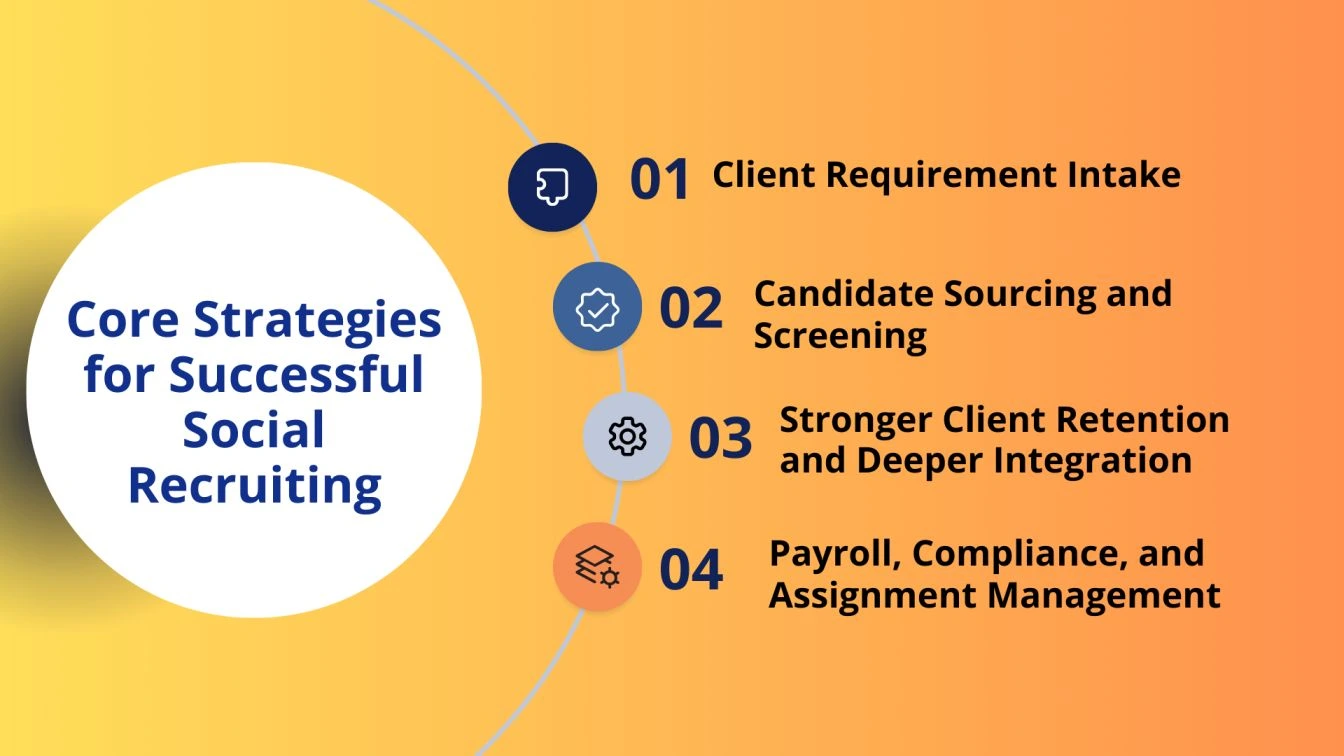
A strong temporary recruitment process is repeatable. Recruiters should not rebuild the workflow every time a client needs cover tomorrow morning. The process below gives agencies a practical structure.
1. Client Requirement Intake
The process starts with a clear job order. Recruiters need more than a job title. They need the exact shift pattern, location, start date, assignment length, pay rate, bill rate, required skills, certifications, dress code, reporting contact, safety requirements, and replacement expectations.
Good intake prevents wasted calls. If the recruiter knows the non-negotiables early, they can search the candidate database with confidence and submit fewer, better-matched people.
2. Candidate Search and Availability Check
Temporary recruitment depends on availability. A qualified candidate who cannot start on time is not a fit for an urgent temp role.
Recruiters usually search their existing database first, then expand to job boards, referrals, previous contractors, social channels, and re-engagement campaigns. The fastest agencies keep availability data current so they can identify ready candidates within minutes.
3. Candidate Vetting and Screening
The agency screens candidates for the role, but also for reliability. In temporary staffing, a no-show can damage the client relationship quickly.
Screening usually covers:
- Recent work history
- Role-specific skills
- Shift availability
- Location and commute fit
- Pay expectations
- Communication responsiveness
- Previous assignment feedback
- Eligibility to work
- Required licenses, certifications, or documents
For regulated roles, the agency may also need background checks, drug testing, health checks, DBS checks, industry certifications, or client-specific compliance steps.
4. Shortlist and Client Submission
Once candidates are vetted, the agency sends the strongest options to the client. A good submission is concise but useful. It should include the candidate’s relevant experience, availability, rate fit, compliance status, and any practical notes that affect the start.
For urgent temporary placement, speed matters. For higher-risk or specialist assignments, accuracy matters even more. The best agencies balance both.
5. Offer, Placement, and Onboarding
After the client confirms a candidate, the agency coordinates the start. This can include assignment confirmation, contract documents, timesheet instructions, site details, safety information, reporting contacts, and first-day expectations.
Temporary onboarding should be simple, but not casual. Workers need to know where to go, who to report to, what to bring, how hours will be tracked, and who to contact if something changes.
6. Assignment Management
Temporary staffing continues after the candidate starts. Recruiters or operations teams track attendance, client feedback, worker satisfaction, timesheets, extensions, replacement needs, and assignment end dates.
This stage is where many agencies either protect the margin or lose it. Missed timesheets, unclear ownership, weak follow-up, and poor replacement planning can turn a filled role into an operational headache.
7. Redeployment
When an assignment ends, the worker should not disappear from the agency’s pipeline. Redeployment turns a completed temporary placement into future revenue.
Agencies should update the candidate record, capture performance feedback, confirm new availability, and match the worker to the next suitable role. This is one of the biggest advantages of a well-maintained temporary workforce CRM.
How Do Temporary Staffing Agencies Vet Candidates?
Vetting temporary workers is about more than checking whether someone can do the job. Agencies also need to know whether the candidate can start when needed, follow assignment instructions, meet compliance requirements, and represent the agency well with the client.
A practical vetting checklist includes:
- Identity and work authorization checks
- Employment history and recent assignment review
- Skills screening for the specific role
- Reference checks where appropriate
- Availability and shift preference confirmation
- Location, travel, and commute feasibility
- Required licenses or certifications
- Background checks for sensitive or regulated roles
- Reliability signals such as responsiveness and previous no-show history
- Client-specific requirements such as uniform, PPE, system access, or safety training
The key is to complete as much of this as possible before a client has an urgent requirement. Pre-vetted candidates make temporary staffing faster and more reliable.
Managing Temporary Staffing Challenges
Temporary staffing can be profitable, but it exposes weak operations quickly. Common challenges include last-minute cancellations, no-shows, missing documents, payroll errors, poor availability data, unclear client requirements, and inconsistent follow-up.
Agencies can manage these challenges by building a more disciplined operating rhythm:
- Keep candidate availability fresh instead of relying on old notes.
- Standardize intake forms for every temporary job order.
- Use clear compliance checklists by role, location, and client.
- Track every submission, placement, start date, and assignment end date.
- Create replacement workflows before an absence becomes a crisis.
- Keep worker communication active between assignments.
- Review fill rates, no-show rates, redeployment rates, and client feedback regularly.
Effective temporary staffing through recruitment agencies comes from process discipline. Speed matters, but speed without visibility creates risk.
Where a Temporary Workforce CRM Helps
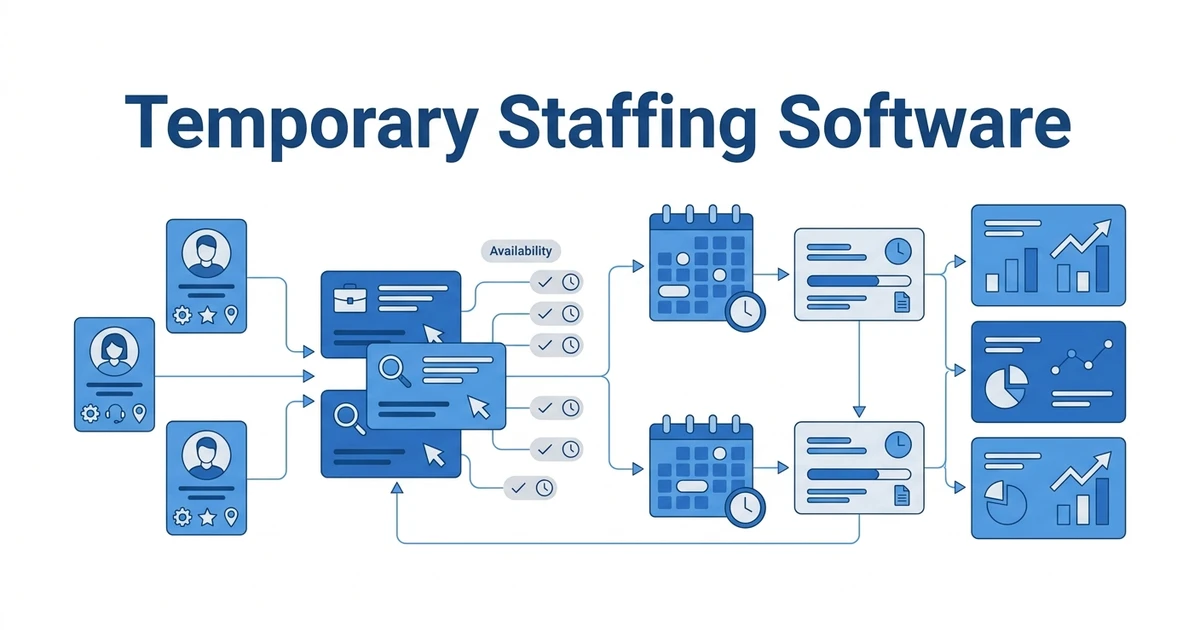
A temporary workforce CRM gives recruiters one place to manage the relationships and records that drive temp placements. Spreadsheets can work for a small desk, but they become fragile when an agency is tracking hundreds of candidates, multiple clients, open shifts, compliance documents, follow-ups, and active assignments.
For temporary staffing teams, a CRM should help organize:
- Client companies and hiring contacts
- Temporary job orders and shift requirements
- Candidate availability and preferences
- Skills, tags, locations, and work history
- Outreach and follow-up activity
- Shortlists and client submissions
- Placement status and assignment dates
- Compliance documents and renewal reminders
- Timesheet or assignment-related notes
- Redeployment opportunities
- Recruiter activity and pipeline reporting
ATZ CRM supports staffing agencies that need a connected workspace for candidate pipelines, client relationships, outreach, submissions, placements, and reporting. If your agency is building a more structured temp desk, explore temporary staffing software and ATS for temporary staffing workflows inside ATZ CRM.
Benefits of Temporary Staffing for Recruitment Agencies
Temporary staffing gives agencies a business model that can be more recurring than permanent placement alone. Instead of waiting for one-off success fees, agencies earn through active assignments and repeat client demand.
Key benefits include:
- More predictable revenue through ongoing assignments
- Faster placement cycles for ready candidates
- Stronger client retention through operational support
- Higher redeployment value from known workers
- Better resilience during permanent hiring slowdowns
- Deeper client relationships because the agency supports day-to-day workforce needs
The commercial upside is real, but it only works when the agency has reliable processes for intake, vetting, compliance, assignment management, and worker communication.
Best Practices for Temporary Staffing Agencies
Strong temporary staffing teams tend to share the same habits.
- Build talent pools before clients ask for urgent cover.
- Segment candidates by skill, location, availability, certifications, and reliability.
- Confirm availability often, especially for high-demand workers.
- Write job orders clearly so recruiters do not chase the wrong people.
- Vet candidates before submitting them to clients.
- Keep placement, compliance, and assignment data in one system.
- Follow up after the first shift, not only when something goes wrong.
- Track redeployment so good workers stay active.
- Measure fill rate, time to fill, no-show rate, extension rate, and gross margin.
- Use automation for reminders, outreach, and follow-up, but keep human ownership clear.
Temporary staffing rewards agencies that are fast and organized. The agencies that scale best usually treat their process like an operating system, not a set of recruiter habits living in separate inboxes.
Conclusion
Temporary staffing works by connecting employers with job-ready workers for short-term needs, while the agency manages the recruitment, vetting, placement, and assignment workflow. It gives clients flexibility, gives workers access to short-term opportunities, and gives recruitment agencies a recurring revenue model when managed well.
For agencies, the real advantage comes from repeatability. Clear intake, pre-vetted candidates, accurate availability, compliant records, fast submission workflows, and strong assignment management all compound over time. A temporary workforce CRM helps keep that system organized so recruiters can spend less time hunting through notes and more time filling roles, supporting clients, and redeploying good workers.
FAQs
What is temporary staffing?
Temporary staffing is the process of supplying workers to a client business for short-term assignments. A staffing agency usually recruits, screens, hires, and manages the worker, while the client directs the work during the assignment.
What is temporary recruitment?
Temporary recruitment is the hiring workflow used to fill temporary roles. It includes client intake, candidate sourcing, availability checks, vetting, compliance, submission, placement, onboarding, and assignment follow-up.
How do temporary staffing agencies work?
Temporary staffing agencies maintain candidate pools, match available workers to client requirements, vet candidates, coordinate temporary placement, manage assignment communication, and support payroll, timesheets, replacements, and redeployment.
How do temporary staffing agencies vet candidates?
Agencies vet candidates by checking skills, work history, availability, references, right-to-work or work authorization, certifications, background checks where needed, reliability, and previous assignment performance.
What is a temporary workforce CRM?
A temporary workforce CRM is software that helps agencies manage candidate pools, client requirements, outreach, availability, compliance records, submissions, placements, assignments, and reporting in one place.
Blog Summary
- Defines temporary staffing meaning in plain language for recruiters, agencies, and clients.
- Explains the temporary recruitment process from client intake to redeployment.
- Shows how temporary staffing agencies vet candidates before submission and placement.
- Covers common temporary staffing challenges such as no-shows, missing documents, payroll errors, and poor availability data.
- Explains how a temporary workforce CRM helps agencies manage candidates, clients, assignments, and repeat placements.